
Introduction: Why Is the Nifty Falling Despite Global Recovery?
Indian stock markets are entering a potentially high-volatility phase as geopolitical tensions, crude oil prices, global bond yields, central-bank policy expectations and key U.S. economic data converge over the next two weeks.
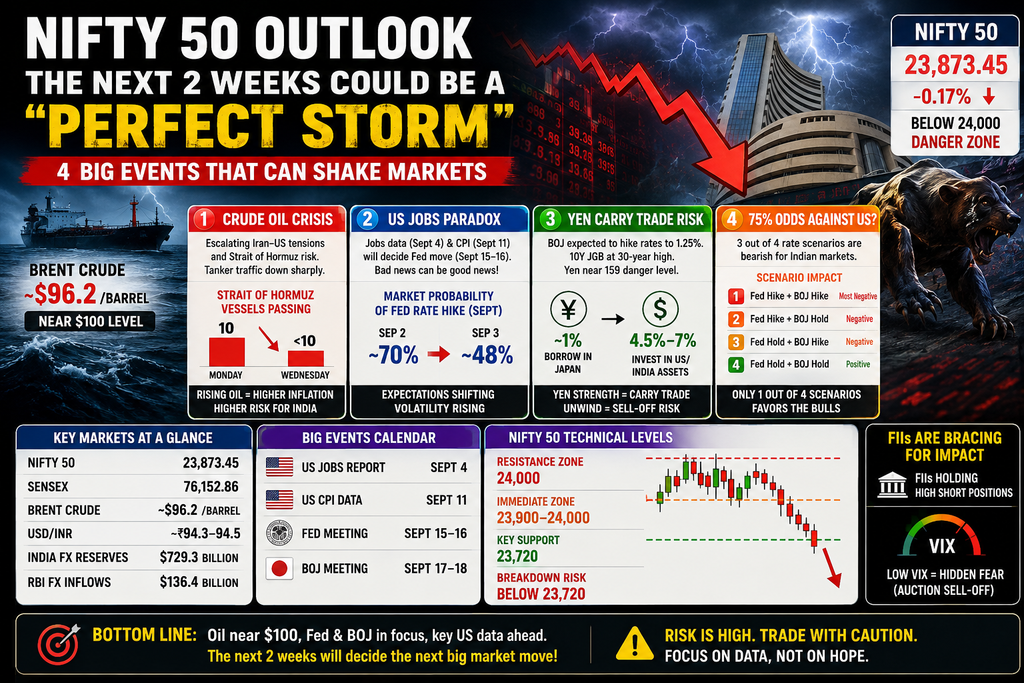
On Thursday, September 3, the Nifty 50 closed at 23,873.45, down 0.17%, while the Sensex declined 0.55% to 76,152.86. The Nifty erased its early gains as rising crude prices and global risk aversion weighed on sentiment. The closing auction session also contributed to the late-session volatility.
The bigger concern is not simply the day’s fall. The issue is that several macro triggers are arriving almost simultaneously.
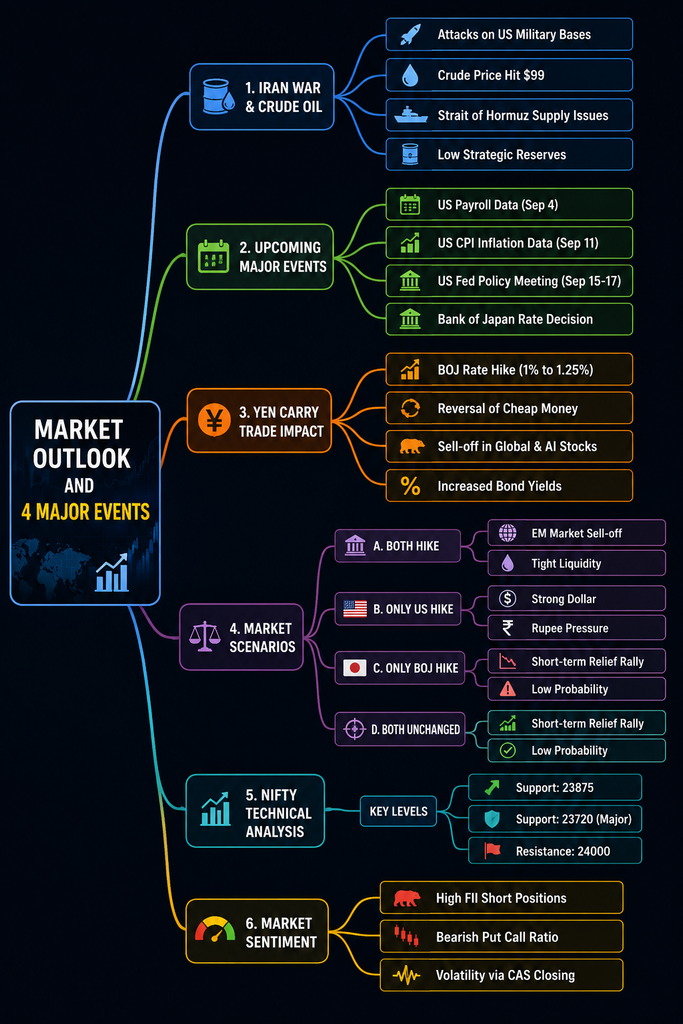
Crude oil is near $96–97 per barrel, the U.S. jobs report is due on September 4, U.S. CPI is scheduled for September 11, the Federal Reserve meets on September 15–16, and the Bank of Japan meets on September 17–18.
That creates a classic volatility cluster.
Key Market Data at a Glance
| Indicator | Latest/Upcoming Data | Why It Matters |
|---|---|---|
| Nifty 50 | 23,873.45 | Below the psychological 24,000 zone |
| Nifty daily move | -0.17% | 4th consecutive declining session |
| Sensex | 76,152.86 | Down 0.55% |
| Brent crude | ~$96.2/barrel | Inflation and India trade-balance risk |
| USD/INR | ~₹94.3–94.5 | Rupee has strengthened recently |
| RBI-linked FX inflows | $136.4 billion | Provides a temporary currency cushion |
| U.S. Jobs Report | September 4 | Major Fed-policy trigger |
| U.S. CPI | September 11 | Inflation signal before FOMC |
| Fed meeting | September 15–16 | Rate decision + policy guidance |
| BOJ meeting | September 17–18 | Yen/carry-trade risk |
| Key Nifty support | 23,720 area | Important downside reference |
| Psychological resistance | 24,000 | Reclaim would improve sentiment |
The rupee is actually providing an important counterpoint to the bearish narrative. It strengthened to around ₹94.30 on September 3 after large FCNR(B)-related inflows, while India’s foreign-exchange reserves were reported at a record $729.3 billion. That gives the RBI considerably more ammunition to manage external shocks.
So, the situation is not simply “everything is bearish.” Instead, the market is balancing strong domestic liquidity support against a worsening global macro backdrop.
1. Crude Oil Near $100: The First Major Risk
The biggest immediate threat for India is crude oil.
Brent crude rose to around $96.22 per barrel on September 3, marking a fourth consecutive day of gains and a six-week high. The move has been driven by escalating U.S.-Iran tensions and concerns about disruption around the Strait of Hormuz.
The Strait of Hormuz is particularly important because it is one of the world’s most strategically important oil-transit routes.
Recent shipping data showed traffic through the strait falling sharply, with only six vessels passing on Wednesday compared with an average of around 13. That does not automatically mean a complete supply shutdown, but it highlights the increasing uncertainty surrounding energy flows.
Why is this dangerous for India?
India is highly sensitive to imported crude prices.
If Brent moves toward:
- $90: manageable but uncomfortable
- $95–100: inflation and current-account concerns increase
- $100+: significant risk for equities, the rupee and bond yields
- $110+: potentially severe macro stress if sustained
Higher crude can increase India’s import bill and inflation expectations while putting pressure on corporate margins.
That is particularly negative for sectors such as:
- Aviation
- Paints
- Tyres
- Chemicals
- Logistics
- Consumer companies with limited pricing power
The good news is that India’s recent FX inflows provide some protection. Reuters reported that India secured around $136.4 billion through one-off measures, helping strengthen the rupee and giving the RBI greater flexibility.
Therefore, the real risk is not merely oil at $96.
The real risk is oil staying above $95–100 for an extended period.
2. September 4 U.S. Jobs Report: The “Bad News Is Good News” Paradox
The second major trigger arrives on September 4, when the U.S. Employment Situation for August is scheduled for release.
This report has become extremely important because the market’s interpretation of economic data has changed.
Normally:
Strong jobs → strong economy → bullish stocks
But in a high-inflation environment:
Strong jobs → stronger inflation pressure → higher-for-longer rates → potentially bearish stocks
This creates the unusual situation where investors may prefer a moderate cooling in the U.S. labor market.
Three possible scenarios
Scenario A: Very strong jobs
This could increase expectations for a Fed hike and push Treasury yields higher.
Potential reaction:
Dollar ↑ → Bond yields ↑ → Equities ↓
Scenario B: Moderate jobs slowdown
This could reduce inflation pressure without immediately creating recession fears.
Potential reaction:
Yields ↓ → Rate-hike expectations ↓ → Equities ↑
This would probably be the most market-friendly outcome.
Scenario C: Extremely weak jobs
Initially, markets could rally on expectations of easier monetary policy.
But if the employment data is significantly weaker than expected, recession fears could overwhelm the rate-cut narrative.
That is why the quality of the jobs report matters more than simply whether payrolls beat or missed expectations.
3. U.S. CPI on September 11: The Inflation Test
The next major event comes on September 11, when the U.S. Consumer Price Index for August is scheduled for release.
This could become even more important because crude oil has risen sharply.
A sustained oil rally can eventually feed into:
Energy prices → transportation costs → producer prices → consumer inflation
That creates a difficult situation for the Federal Reserve.
If CPI comes in hot while crude remains elevated, the Fed may have less flexibility to adopt a dovish stance.
If CPI cools significantly, the market could begin pricing out some of the expected tightening pressure.
4. Fed September 15–16: The Biggest Macro Event
The Federal Reserve’s September meeting is scheduled for September 15–16, 2026.
This is where the previous two weeks of data eventually converge.
The market has experienced a dramatic change in rate expectations.
On September 2, reports citing CME FedWatch showed the probability of a September rate hike around 70%, compared with roughly 37% one week earlier.
However, this probability is extremely sensitive to incoming data.
By September 3, another market update showed the implied probability of a September hike falling to around 48.4%, with 51.6% priced for no change, after comments suggesting that some Fed officials were less inclined toward an immediate hike.
This is the key point:
70% is not a guaranteed Fed hike.
It is market pricing, and market pricing can change dramatically within hours when jobs, inflation or Fed communication changes.
For Indian investors, the important variables are:
Fed decision + U.S. 10-year yield + Dollar + crude oil + FII flows
A hawkish Fed combined with higher crude would be a particularly difficult combination for emerging markets.
5. Bank of Japan and the Yen Carry Trade
The second central-bank event comes immediately after the Fed.
The Bank of Japan is scheduled to meet on September 17–18, making this one of the most important events for global liquidity. Reuters reported that markets are increasingly expecting another BOJ hike after Governor Kazuo Ueda signaled that a September increase is a strong possibility if inflation risks continue to build.
A Reuters poll had already shown economists expecting the BOJ to raise its policy rate to 1.25% during September.
Why does this matter to India?
Because of the yen carry trade.
For years, investors could borrow relatively cheaply in yen and invest in higher-yielding assets elsewhere.
Simplified example:
Borrow in Japan → convert to dollars → buy U.S. bonds/equities or emerging-market assets
If Japanese interest rates rise and the yen strengthens, that trade becomes less attractive.
Investors may then start reducing leveraged positions.
That can create:
Yen appreciation → Carry-trade unwinding → Global deleveraging → Emerging-market selling
This is why a BOJ hike can matter to Indian equities even though Japan is thousands of kilometres away.
The 3-to-1 Bearish Scenario: Is the 75% Probability Really Valid?
A simple framework is often used to describe the next two weeks:
Scenario 1: Fed hikes + BOJ hikes
Potentially the most negative combination.
Higher U.S. and Japanese rates could increase pressure on global liquidity.
Scenario 2: Fed hikes + BOJ holds
The dollar could strengthen while emerging-market currencies face pressure.
For India, this could increase concerns about:
- Rupee depreciation
- FII selling
- Higher imported inflation
- Bond yields
Scenario 3: Fed holds + BOJ hikes
This could still create volatility through the yen carry trade.
The immediate impact might be less severe than simultaneous Fed and BOJ tightening, but global leveraged positions could still come under pressure.
Scenario 4: Fed holds + BOJ holds
This is arguably the cleanest short-term scenario for risk assets.
It could allow:
- Bond yields to cool
- Dollar pressure to ease
- Crude concerns to stabilize
- FIIs to rebuild risk positions
But there is an important mathematical caveat.
It is tempting to say:
3 bearish scenarios ÷ 4 total scenarios = 75% bearish probability.
But that is not a genuine probability calculation.
The four scenarios do not have equal probabilities.
Therefore, 75% should be presented as a scenario framework, not as a statistically calculated probability of a market fall.
This distinction makes the analysis more credible.
Nifty 50 Technical Setup: 24,000 vs 23,720
The technical picture is also becoming important.
The Nifty closed at:
23,873.45
That leaves the index below the psychologically important 24,000 level.
The current structure can be simplified as:
Above 24,000
A sustained reclaim could improve sentiment and potentially trigger short covering.
23,900–24,000
This is the immediate recovery zone.
Failure here would indicate that sellers remain active on rallies.
23,720
This becomes an important downside reference/support zone.
A decisive break below this area could increase the probability of another leg lower.
Below 23,720
The market could enter a deeper correction phase, particularly if the breakdown occurs alongside:
- Brent above $100
- Higher U.S. yields
- Strong dollar
- Weak global equities
- Heavy FII selling
The recent close also needs to be interpreted carefully because the late-session auction contributed to the final index move. The Nifty nevertheless ended the day lower for a fourth consecutive session.
FIIs vs Domestic Liquidity: An Important Twist
One of the most interesting developments is that foreign flows and market performance are not moving in a simple direction.
India reportedly saw around $3.2 billion of foreign institutional inflows during August, the strongest monthly inflow since September 2024, yet the Nifty and Sensex still declined more than 1% during the month.
At the same time, India’s massive recent FX inflows have strengthened the rupee and provided the RBI with additional liquidity-management flexibility.
This suggests that the Indian market is not currently suffering from a straightforward “foreign investors are leaving India” story.
Instead, investors are dealing with a more complicated equation:
Domestic liquidity + strong growth
versus
Oil + global yields + geopolitical risk + monetary-policy uncertainty
That is why the market can remain weak even when India’s underlying economic growth story looks strong.
Why 7.8% GDP Growth Has Not Guaranteed a Rally
India’s strong growth numbers should theoretically support equities.
But markets do not trade purely on GDP growth.
A company can operate in an economy growing at 7.8% and still face:
- Higher crude prices
- Higher financing costs
- Currency volatility
- Weak global demand
- Foreign investor risk reduction
- Higher bond yields
Therefore:
Strong GDP ≠ automatically bullish stock market
The market is currently focusing more heavily on the cost of capital and external risks.
The Real “Perfect Storm” Equation
The next two weeks become dangerous if several variables move in the same direction.
Bearish combination
Brent ↑
U.S. CPI ↑
Fed hike expectations ↑
U.S. 10Y yield ↑
Yen strengthens
Carry trade unwinds
FII selling ↑
=
Higher probability of aggressive market volatility
On the other hand:
Bullish/relief combination
Oil stabilizes
Jobs data cools moderately
CPI falls
Fed turns less hawkish
BOJ remains cautious
U.S. yields decline
=
Potential short-covering rally in equities
What Should Traders Watch Now?
Instead of trying to predict the exact Nifty closing level, traders should monitor five live indicators.
1. Brent Crude
Below $95: pressure could ease.
$95–100: caution zone.
Above $100: major risk signal.
2. U.S. 10-Year Treasury Yield
A sustained move toward or above 5% would increase pressure on global growth stocks and emerging markets. Recent reports have already highlighted the risk of the 10-year yield approaching that level.
3. USD/INR
The rupee recently strengthened toward ₹94.30, helped by substantial FX inflows.
If the rupee remains stable despite elevated crude, it would indicate that India’s external buffers are absorbing some of the shock.
4. Nifty 24,000
24,000 reclaim = bullish improvement
23,900 rejection = continued weakness
23,720 breakdown = bearish acceleration risk
5. India VIX
A rising VIX combined with a Nifty breakdown would provide stronger confirmation that the market is moving from normal correction toward a more volatile risk-off phase.
Final Verdict: Correction Risk Is High, But a Crash Is Not Guaranteed
The next two weeks are unusually important for global markets.
The sequence is clear:
September 4 → U.S. Jobs
September 11 → U.S. CPI
September 15–16 → Federal Reserve
September 17–18 → Bank of Japan
And all of this is happening while Brent crude is near $100 and geopolitical tensions remain elevated.
For the Nifty, the immediate battlefield is between 24,000 on the upside and 23,720 on the downside.
A sustained move above 24,000 could invalidate part of the bearish setup and trigger short covering.
A decisive break below 23,720, especially with crude above $100 and global yields rising, could dramatically increase downside volatility.
The biggest lesson is therefore not “the market will crash.”
It is:
The probability of large moves is increasing, and traders should be prepared for both directions.
The coming fortnight will be less about guessing the next candle and more about watching the interaction between oil, inflation, central banks, bond yields, currencies and FII positioning.
For investors, this is a period where risk management may matter more than aggressive dip-buying.
SEO Keywords
Primary Keywords:
Nifty 50 prediction September 2026, Indian stock market, Nifty today, stock market crash, Fed rate hike September 2026, Bank of Japan rate hike, crude oil price, Nifty support resistance
Secondary Keywords:
Nifty 24000 resistance, Nifty 23720 support, FII selling India, US CPI September 2026, US jobs report September 2026, Fed interest rate decision, yen carry trade, USD INR, Brent crude, India VIX
Long-tail Keywords:
- Why Nifty is falling despite global markets rising
- Will Nifty break 23720
- Fed rate hike impact on Indian stock market
- Crude oil $100 impact on Nifty
- BOJ rate hike impact on Indian stocks
- Nifty September 2026 outlook
- Indian stock market next two weeks
- FII selling and Nifty prediction
- September 2026 stock market volatility
Disclaimer
This article is for educational and informational purposes only and should not be considered investment advice, a recommendation to buy or sell securities, or a guarantee of future market performance. Market conditions can change rapidly, particularly around geopolitical events, economic data releases and central-bank decisions. Investors should conduct their own research and consult a SEBI-registered financial adviser before making investment decisions.
Top 10 SEO Titles
- Nifty 50 Outlook: Why the Next 2 Weeks Could Trigger a Major Market Volatility Storm
- Nifty Prediction September 2026: 4 Big Events That Could Shake Indian Markets
- Nifty 50 Crash Risk? Fed, BOJ, Crude Oil & CPI Put Markets on High Alert
- Indian Stock Market Outlook: Why the Next 14 Days Could Be Extremely Volatile
- Nifty at 23,873: Will 23,720 Break? Fed, Crude Oil & BOJ Hold the Key
- Stock Market Warning: 5 Global Triggers That Could Decide Nifty’s Next Move
- Nifty 50 Under Pressure: Is a Bigger Correction Coming in September 2026?
- Fed Rate Hike, BOJ & $100 Crude: Why Nifty Faces a Perfect Storm
- Nifty September 2026 Prediction: 24,000 Resistance vs 23,720 Support Explained
- Market Crash Ahead? Fed, BOJ, Oil & FII Flows Create a High-Risk Window for Nifty