

Introduction: Why Are Foreign Investors Selling Indian Stocks?
The Indian stock market entered October 2026 under significant pressure as foreign portfolio investors (FPIs), elevated crude oil prices, a weakening rupee, and rising global bond yields weighed on investor sentiment.
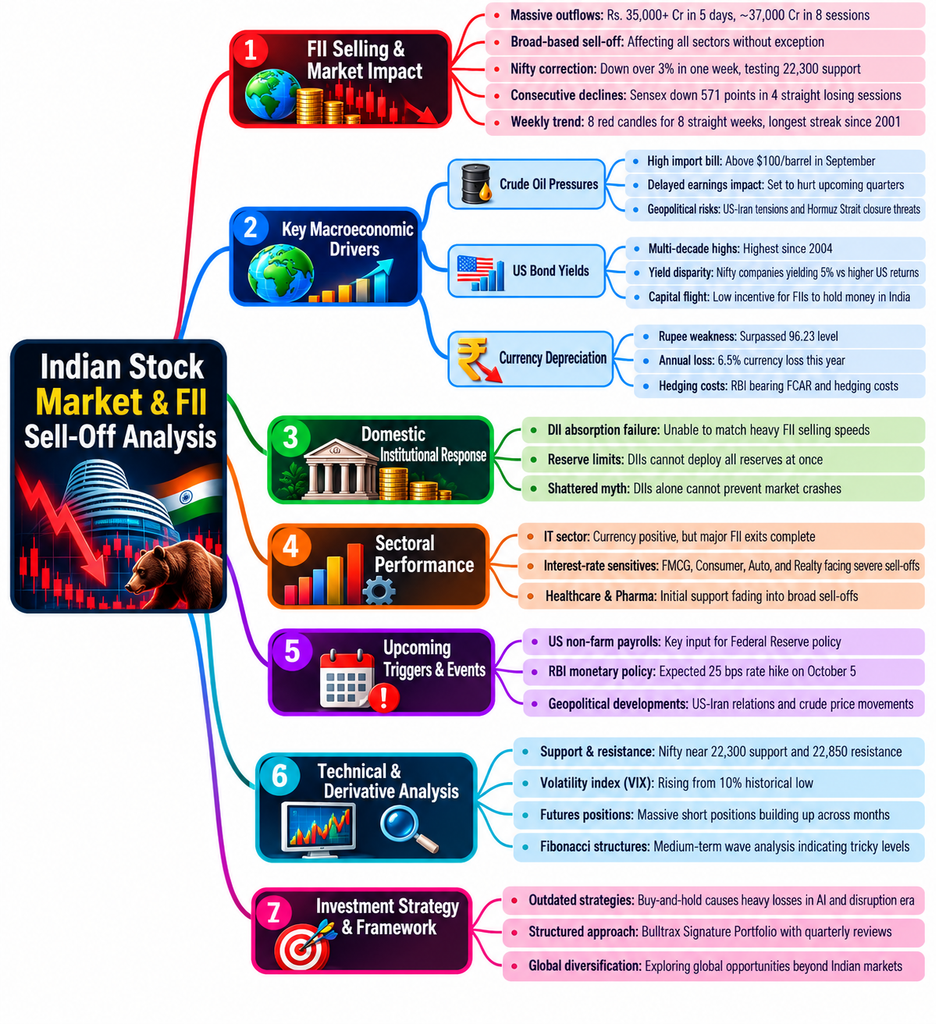
In September 2026, foreign portfolio investors withdrew approximately ₹46,000 crore from Indian equities, including around ₹10,148 crore of net selling on September 30. The Nifty 50 ended September at 22,620.45, down approximately 6.1% for the month. On October 1, the market experienced another sharp decline, with the Nifty moving below the closely watched 22,300 level.
These developments raise an important question: why are international investors reducing their exposure to Indian equities, and what could their selling mean for retail investors?
The answer involves more than one factor. Currency depreciation, global interest rates, energy prices, relative valuations and portfolio rebalancing can all influence how foreign investors allocate capital.
Here are five key factors behind the current market pressure and the indicators investors should monitor next.
1. The ₹46,000 Crore Foreign Investor Exit: Why Domestic Buying Has Not Prevented the Decline
September’s foreign investor outflows were substantial. According to reported NSDL and BSE data, FPIs sold approximately ₹46,000 crore of Indian equities during the month, including about ₹10,148 crore on September 30 alone.
September 2026 market data
| Indicator | Reported figure |
|---|---|
| September FPI equity outflow | Approximately ₹46,000 crore |
| September 30 FPI net selling | Approximately ₹10,148 crore |
| Nifty 50 September closing level | 22,620.45 |
| Nifty monthly decline | Approximately 6.1% |
| Sensex September decline | Approximately 5.8% |
Figures are rounded and refer to the reported September 2026 period. Sources: Times of India and Reuters.
Why domestic institutional investors cannot guarantee market stability
Domestic institutional investors, including mutual funds, insurance companies and other financial institutions, can help absorb foreign selling. However, their purchases do not guarantee that stock prices will remain stable.
There are several reasons:
- Different investment objectives: Domestic institutions may have different mandates, time horizons and liquidity requirements.
- Uneven demand: Buying in a few large-cap stocks may not offset selling across the broader market.
- Valuation adjustments: When investors lower their earnings expectations or demand a higher return, stock prices can decline even when other investors are buying.
- Global allocation changes: International investors may reduce exposure to several emerging markets at the same time.
A useful distinction is that foreign selling measures an investment flow, not the intrinsic value of every stock being sold.
What investors should watch: Track daily and monthly FPI and DII flows together with market breadth, trading volumes, valuations and earnings revisions. One day’s institutional activity should not be treated as a reliable signal of the market’s next direction.
2. Rupee Weakness: How Currency Depreciation Affects Foreign Investor Returns
The Indian rupee is another important factor in foreign portfolio decisions.
On October 1, 2026, the rupee weakened approximately 0.5% to 96.3150 per US dollar, its lowest level in two months, amid rising global bond yields, higher oil prices and continued capital outflows.
How exchange rates affect an international investor
Consider a hypothetical investment of ₹10,000 in Indian shares when the exchange rate is ₹90 per US dollar.
The investor initially converts approximately $111.11 into rupees. If the investment remains worth ₹10,000 but the exchange rate moves to ₹96 per dollar, the investment is worth approximately $104.17.
In this example, the investment has lost value in dollar terms even though the rupee value of the shares has not changed.
The calculation excludes transaction costs, taxes, dividends and any currency hedging.
Why the rupee is under pressure
Several factors can contribute to currency weakness:
- Crude oil imports: Higher oil prices increase India’s foreign-currency payment requirements.
- Foreign portfolio outflows: Investors selling Indian assets may convert the proceeds into other currencies.
- US Treasury yields: Higher returns available on US government debt can influence global capital allocation.
- Global risk aversion: Geopolitical uncertainty can increase demand for currencies and assets perceived as safer.
- Currency expectations: Investors may reduce unhedged exposure when they expect additional exchange-rate volatility.
However, currency depreciation does not automatically imply that every foreign investor will sell. Some investors hedge currency exposure, and others may consider lower rupee-denominated valuations attractive.
What investors should watch: Monitor USD/INR, crude oil, foreign investor flows, and changes in US Treasury yields together. The relationship between these indicators can change over time.
3. RBI’s Policy Dilemma: Inflation Control Versus Economic Growth
Rising energy prices and currency weakness can create a difficult environment for monetary policy. The Reserve Bank of India must consider inflation, economic growth, financial stability,y and currency conditions when deciding whether to change interest rates.
A higher policy rate can influence inflation expectations and borrowing costs, but it can also put pressure on interest-sensitive businesses. Keeping rates unchanged may support borrowing conditions, while leaving some inflation and currency risks unresolved if external pressures intensify.
Neither outcome guarantees a particular market reaction.
Two possible RBI policy scenarios
| Policy scenario | Potential implications |
|---|---|
| Repo rate unchanged | May support borrowers in the near term, but inflation and currency risks could remain |
| 25-basis-point rate increase | Could signal a response to inflation pressures, while increasing borrowing costs for some businesses |
| Larger rate increase | Could create additional volatility in rate-sensitive sectors, depending on the policy rationale and market expectations |
These are analytical scenarios, not confirmed RBI decisions or predictions.
Which sectors could be affected?
- Banking and NBFCs: Funding costs, lending yields, deposit competition and credit quality matter.
- Real estate and housing finance: Mortgage affordability and project financing costs are important.
- Automobiles: Vehicle financing costs can influence demand.
- FMCG and consumer businesses: Higher inflation can affect household purchasing power and input costs.
- Capital goods: Borrowing costs and investment decisions can affect demand.
The impact of interest rates varies across individual companies. A bank’s performance, for example, depends on deposit costs, lending yields, asset quality, liquidity and capital adequacy rather than the repo rate alone.
What investors should watch: Official RBI policy announcements, inflation releases, government bond yields, credit growth and company earnings. Treat forecasts of a rate increase as expectations until the RBI publishes its decision.
4. Crude Oil and Global Bond Yields: Two External Risks for Indian Equities
India’s dependence on imported crude oil means sustained increases in global energy prices can influence inflation, currency stability and corporate profitability.
On September 28, Brent crude surged to around $108.20 per barrel amid concerns about Middle East tensions and potential supply disruptions. On October 1, reports continued to highlight oil prices above $100 per barrel alongside a sharp increase in global bond yields.
Why expensive oil matters
Higher crude prices can:
- Increase the cost of India’s energy imports.
- Put pressure on the rupee and the current account.
- Increase transportation and manufacturing expenses.
- Affect margins in aviation, paints, chemicals and logistics.
- Increase inflation risks and complicate monetary policy.
The effect differs by industry. Oil producers, refiners and businesses with pricing power may respond differently from companies that absorb higher input costs.
Why US Treasury yields matter
The US 10-year Treasury yield reached approximately 5.34% on October 1, 2026, according to Reuters. Higher US yields can influence the relative attractiveness of emerging-market assets and affect the discount rates used to value future corporate earnings.
However, US yields alone do not determine foreign investment flows. Investors also assess currency risks, earnings growth, valuations, liquidity and geopolitical developments.
Three possible macroeconomic scenarios
| Scenario | Possible market implications |
|---|---|
| Oil prices decline and global yields moderate | Could reduce some pressure on inflation, currency and valuations |
| Oil and yields remain elevated | Could prolong uncertainty around margins, capital flows and interest rates |
| Oil rises further while yields increase | Could intensify pressure on imported inflation, borrowing costs and equity valuations |
These scenarios are conditional. They should not be interpreted as price targets or predictions about the timing of a market recovery.
What investors should watch: Brent crude, USD/INR, US Treasury yields, Indian government bond yields and corporate earnings guidance.
5. Is Buy-and-Hold Investing Dead? Why Portfolio Risk Management Matters
A market correction can make long-term investors question whether a buy-and-hold approach still works. However, a prolonged decline does not by itself prove that long-term investing has become ineffective.
Long-term investment outcomes depend on the businesses owned, the price paid, earnings growth, balance-sheet strength, portfolio diversification and the investor’s time horizon.
A weak business can remain a poor investment even after its share price falls substantially. Conversely, a financially sound business may recover after temporary economic or market pressures ease.
How investors can review their portfolios
Separate core investments from tactical positions. Long-term holdings and short-term trades should have distinct objectives, time horizons and exit rules.
Review company fundamentals. Check revenue growth, margins, cash flow, debt, competitive advantages and management guidance.
Assess concentration risk. A portfolio heavily weighted toward one sector can suffer when that industry faces a common macroeconomic shock.
Avoid automatic averaging down. A lower share price does not necessarily mean a better valuation. Additional purchases should depend on updated fundamentals and the original investment thesis.
Maintain liquidity. Keeping some cash available can reduce the need to sell long-term investments during market stress.
Use position sizing and predefined risk limits. Decide how much capital can be exposed to an individual company or trading position before making a transaction.
Review investments periodically. Quarterly portfolio reviews can help identify deteriorating fundamentals, valuation changes and concentration risks without requiring a reaction to every daily price movement.
A practical checklist for stock selection
| Factor | Questions to ask |
|---|---|
| Valuation | Is the stock reasonably valued relative to earnings, cash flow and peers? |
| Earnings | Are revenue and profit expectations improving or deteriorating? |
| Balance sheet | Can the company manage its debt and interest expenses? |
| Cash flow | Does reported profit translate into operating cash flow? |
| Competitive position | Can the company defend its market share and margins? |
| Portfolio fit | Does the position create excessive sector or company concentration? |
What investors should watch: Business performance and valuation rather than the headline FPI selling figure alone. Institutional outflows can create volatility, but they do not establish whether a particular stock is overvalued or undervalued.
Nifty 50 Technical Analysis: Is 22,300 Still an Important Level?
Technical levels can help traders define scenarios and manage risk, but they should be updated as prices move.
The September 30 closing level of 22,620.45 was followed by a further decline on October 1. Financial Express reported that Nifty fell below 22,300 during the October 1 sell-off.
This means 22,300 should no longer be described as an untouched support level. It is a price area to monitor for possible recovery attempts or continued weakness.
Technical monitoring framework
| Price area | Interpretation to monitor |
|---|---|
| Above 22,850 | Potential improvement in short-term price structure if the move holds |
| 22,300–22,850 | Zone to monitor for recovery attempts, rejection or consolidation |
| Below 22,300 | Continued downside risk if the breakdown persists |
| Lower levels | Should be calculated from updated charts and historical price structure |
These are monitoring zones based on the supplied draft and recent market reporting, not independently verified trading signals or guaranteed support and resistance levels.
What about India VIX and Elliott Wave analysis?
India VIX measures expected near-term market volatility derived from Nifty options prices. A rising VIX can indicate greater uncertainty, but it does not predict the direction of the next market move.
Elliott Wave analysis is another technical framework used by some traders to interpret price patterns. Its wave counts can be subjective, and a projected Wave 3 decline should not be presented as a confirmed event merely because a support level breaks.
For traders, technical analysis should be combined with position sizing, predefined stop-loss rules, liquidity considerations and awareness of event risk.
What Could Happen Next? Three Market Scenarios for October 2026
Instead of attempting to predict the exact market bottom, investors can prepare for different outcomes based on observable indicators.
Scenario 1: Market recovery
Conditions to monitor
Crude oil prices moderate, global bond yields stabilise, FPI selling slows, and corporate earnings expectations improve.
Potential implication: improved investor confidence and a possible relief rally.
Scenario 2: Volatile consolidation
Conditions to monitor
Crude remains elevated, investors await RBI policy clarity and institutional flows remain mixed.
Potential implication: choppy trading, intermittent rebounds and continued uncertainty.
Scenario 3: Further correction
Conditions to monitor
Energy prices rise further, currency weakness continues, foreign selling intensifies,s and earnings expectations deteriorate.
Potential implication: additional downside pressure and higher market volatility.
These scenarios are conditional analytical frameworks, not forecasts, assigned probabilities or investment recommendations.
Conclusion: What Does the ₹46,000 Crore FPI Exit Mean for Investors?
The September 2026 foreign investor outflow highlights the interaction between global financial conditions and domestic market performance. Currency depreciation, elevated crude oil prices, higher USTreasury yields, ds and uncertainty about monetary policy have contributed to the pressure on Indian equities.
However, foreign selling alone does not determine the long-term value of Indian companies. Investors still need to examine valuations, earnings, cash flows, debt and business quality.
The key points to remember are:
- Foreign portfolio outflows can increase selling pressure but do not guarantee a further decline.
- Rupee depreciation can reduce unhedged dollar returns for international investors.
- RBI policy decisions involve trade-offs between inflation, growth and financial stability.
- Crude oil and global bond yields are important variables for India’s economic outlook.
- The Nifty’s movement around 22,300 requires updated price confirmation rather than assumptions about a guaranteed recovery or breakdown.
- Portfolio diversification, position sizing, liquidity management and fundamental research remain important during volatile periods.
The market bottom cannot be established from one indicator or one day’s trading. Investors can make more informed decisions by monitoring new evidence, reassessing risk and avoiding assumptions that every correction is either a buying opportunity or the beginning of a prolonged decline.
Frequently Asked Questions (FAQs)
1. Why are FIIs selling Indian stocks in 2026?
Foreign investors’ decisions can reflect a combination of currency depreciation, global bond yields, crude oil prices, equity valuations, geopolitical uncertainty, and portfolio reallocation. These factors may affect different investors differently.
2. How much money did foreign investors withdraw from Indian equities in September 2026?
Reported data put September FPI equity outflows at approximately ₹46,000 crore, including roughly ₹10,148 crore of net selling on September 30.
3. How does a weaker rupee affect FII returns?
When foreign investors convert rupee-denominated investments back into dollars, a weaker rupee can reduce their dollar returns if the currency exposure is unhedged and the share price does not rise enough to offset the depreciation.
4. Will the RBI increase interest rates in October 2026?
A rate increase is one possible response to persistent inflation pressures, but the decision depends on the RBI’s assessment of inflation, growth, currency conditions and financial stability. Investors should consult the official policy announcement rather than rely on forecasts.
5. Is 22,300 a confirmed Nifty support level?
No. The level was identified in the original technical analysis as a potential support area, but Nifty subsequently moved below it during the October 1 sell-off. Traders should reassess technical levels using updated charts and price data.
6. Should investors sell their stocks because FIIs are selling?
FPI flows alone are not sufficient to determine whether an individual stock should be sold. Investors should review the company’s fundamentals, valuation, portfolio concentration, investment horizon and personal risk tolerance.
7. Is long-term buy-and-hold investing still relevant?
It can remain suitable for some investors, provided they understand the risks and evaluate business quality, valuations and portfolio concentration. A long holding period does not guarantee a profit or eliminate the risk of permanent capital loss.
Disclaimer
This article is for educational and informational purposes only and does not constitute financial advice, investment advice or a recommendation to buy, sell or hold any security. Market data, technical levels, economic indicators and policy expectations may change without notice. Scenario analysis does not guarantee future market performance. Readers should verify information independently, conduct their own research and consult a qualified financial advisor before making investment decisions. Stock market investments are subject to market risks, including the potential loss of capital.
Top 10 SEO Titles
- Why FIIs Are Selling Indian Stocks in 2026: ₹46,000 Crore Exit Explained
- FII Selling in India: 5 Reasons Behind the Stock Market Crash
- Indian Stock Market Crash 2026: Why Nifty and Sensex Are Falling
- Why Are Foreign Investors Dumping Indian Stocks? Key Reasons Explained
- ₹46,000 Crore FII Outflow: Impact on Nifty 50 and Indian Investors
- Nifty 50 Market Outlook October 2026: FII Selling, Crude Oil and Rupee
- FII vs DII Data: How Foreign Investor Selling Affects the Indian Market
- Rupee at 96 Against Dollar: Why Foreign Investors Are Selling Indian Equities
- Nifty Below 22,300: Support Levels, Market Risks and Recovery Scenarios
- Indian Stock Market Analysis: FII Outflows, RBI Policy and Global Risks