

India’s ₹17.7 Lakh Crore SIP Illusion: Are Retail Investors Funding an FII Exit Strategy?
For years, Indian investors have heard one message repeatedly:
“Just keep investing through SIPs. Time in the market beats timing the market.”
That advice has worked exceptionally well during long bull markets.
But today, India’s equity market has entered a completely different phase.
Monthly SIP inflows have crossed ₹31,000 crore, total SIP Assets Under Management (AUM) have reached an unprecedented ₹17.7 lakh crore, and domestic investors continue buying every market dip.
Meanwhile, Foreign Institutional Investors (FIIs) continue booking profits whenever valuations become expensive.
This raises an uncomfortable question:
Are retail investors creating long-term wealth, or are they unknowingly becoming exit liquidity for global institutions?
The answer isn’t black or white—but the risks deserve serious attention.
India’s SIP Machine Has Never Been Stronger
Indian mutual funds have become one of the world’s largest retail investment ecosystems.
Current Numbers
| Metric | Latest Figure |
|---|---|
| Monthly SIP Contribution | ₹31,781 Crore |
| SIP Accounts | 9+ Crore |
| SIP AUM | ₹17.70 Lakh Crore |
| Mutual Fund Industry AUM | ₹75+ Lakh Crore |
| Monthly Equity MF Inflows | ₹20,000–25,000 Crore |
Every month, regardless of valuation, thousands of crores automatically enter Indian equities.
This creates a structural buying force that didn’t exist a decade ago.
The Biggest Risk: Price No Longer Matters
Benjamin Graham famously said:
“Price is what you pay. Value is what you get.”
Today’s SIP culture often ignores the first half of that sentence.
Many investors now buy:
- whether markets are cheap,
- fairly valued,
- expensive,
- or historically overvalued.
Automation has replaced valuation.
Imagine purchasing a house worth ₹1 crore for ₹2 crore simply because EMI deductions happen automatically every month.
That’s effectively what many investors may be doing when buying companies trading at extremely stretched valuations.
India’s Valuation Premium Has Become Extraordinary
India has always deserved a premium due to:
- higher GDP growth
- political stability
- demographics
- digital adoption
But today’s premium has become historically large.
NSE Valuation Snapshot
- Around 36% of NSE Top 500 companies now trade above 50x P/E
- Before COVID, that figure was roughly 16%
- Several quality companies continue trading near record valuation multiples despite slowing earnings growth.
That doesn’t automatically mean markets will crash.
It simply means future returns become increasingly dependent on earnings growth catching up with prices.
Expensive India vs Cheaper Global Technology
One of the most interesting valuation anomalies today is the difference between Indian consumer companies and global technology leaders.
| Company | P/E | Growth Picture |
|---|---|---|
| Nestlé India | ~76x | Moderate revenue growth |
| Asian Paints | ~61x | Earnings pressure |
| HUL | ~32x | Low single-digit profit growth |
| TSMC | ~36x | Strong semiconductor demand |
| Meta Platforms | ~23x Forward | AI-driven advertising growth |
| Micron Technology | ~5.5x Forward | Memory cycle recovery |
This comparison doesn’t mean Indian companies are “bad.”
Instead, it highlights how much optimism is already priced into many domestic stocks.
When expectations become too high, even good businesses can produce disappointing investment returns.
Retail vs Foreign Institutions: A Silent Tug of War
Indian markets today are largely supported by Domestic Institutional Investors (DIIs).
Recent trend:
- DIIs purchased roughly ₹85,000 crore
- FIIs sold around ₹50,000 crore
Retail money enters through:
- SIPs
- retirement savings
- monthly salary investments
FIIs, however, allocate capital globally.
When India becomes expensive relative to:
- US AI stocks
- semiconductor companies
- global technology leaders
capital naturally rotates elsewhere.
That isn’t manipulation.
It’s global asset allocation.
Why FIIs Often Sell Into Strength
Institutional investors typically ask:
Where can every dollar generate the highest future return?
If:
- India trades at 45–60x earnings
- another market trades at 20–30x with stronger earnings growth
many global funds will rebalance.
Retail investors often interpret this as “FIIs don’t believe in India.”
In reality,
they may simply believe another market currently offers better risk-adjusted returns.
The SIP Stoppage Ratio Is Worth Watching
One indicator receiving increasing attention is the SIP Stoppage Ratio.
Earlier:
- around 42.8%
Recently:
- climbed close to 100
A higher ratio means nearly as many SIPs are being discontinued as newly registered.
Possible reasons include:
- job uncertainty
- household cash-flow pressure
- disappointing short-term returns
- changing financial priorities
One month’s data doesn’t define a trend, but sustained deterioration deserves monitoring.
Banks Face an Unexpected Challenge
India’s banking system is experiencing another structural issue.
Household savings increasingly move into:
- Mutual Funds
- Equity
- ETFs
instead of:
- Fixed Deposits
- Savings Accounts
Banks require deposits to fund:
- loans
- infrastructure
- businesses
- housing finance
Slower deposit growth has already become a concern for several lenders.
This explains why policymakers increasingly focus on financial system stability rather than only stock market growth.
Are SIPs Really Risk-Free?
Absolutely not.
SIPs reduce timing risk.
They do not eliminate:
- valuation risk
- business risk
- economic risk
- behavioural risk
Many investors mistakenly assume:
SIP = Guaranteed Wealth.
History shows otherwise.
Long periods of flat returns have occurred after markets became excessively expensive.
Examples include:
- Japan (1990s)
- US Nasdaq (2000)
- China (2015)
- Several emerging markets
Valuation always matters eventually.
Gold vs Equity: Different Wealth Builders
Indian families traditionally accumulated wealth through:
- physical gold
- land
- fixed assets
Today’s generation increasingly prefers:
- mutual funds
- direct equity
- ETFs
Neither approach is universally superior.
Gold provides:
- inflation protection
- crisis hedge
- lower correlation
Equities provide:
- long-term earnings growth
- ownership in businesses
- potentially higher returns over decades
A balanced portfolio generally benefits from both rather than treating them as substitutes.
The Real Return Investors Should Measure
Many investors celebrate:
“My portfolio earned 10%.”
But returns should always be measured against opportunity cost.
Example:
| Investment | Return |
|---|---|
| Fixed Deposit | 7% |
| Inflation | 5% |
| Portfolio Return | 10% |
Your purchasing power has improved only marginally.
If you’re taking significantly higher equity risk, your expected return should comfortably exceed safer alternatives over long periods.
Smart Investors Should Ask These Questions
Before investing through SIPs, ask yourself:
✔ Is the company’s earnings growing fast enough?
✔ Am I buying because valuations make sense?
✔ Am I diversified across sectors?
✔ Am I investing based on conviction instead of headlines?
✔ Could this stock still deliver attractive returns if its valuation normalizes?
These questions matter far more than simply increasing monthly SIP amounts.
Key Takeaways
- India’s SIP ecosystem has become one of the strongest structural liquidity sources in global markets.
- High SIP inflows have reduced the frequency of deep market corrections.
- Valuations across many sectors remain historically elevated.
- FIIs continue rotating capital globally based on relative opportunities.
- SIPs remain an excellent long-term investing tool—but they are not a substitute for valuation discipline.
- Investors should focus on business quality, earnings growth, diversification, and realistic return expectations rather than assuming markets always rise.
Final Thoughts
India’s long-term economic story remains compelling. Strong demographics, digital transformation, manufacturing growth, and rising financialization continue to support the equity market.
However, optimism alone does not justify paying any price.
SIPs are one of the best wealth-building tools available—but like every financial tool, their effectiveness depends on what you buy, at what valuation, and for how long you stay invested.
The smartest investors don’t stop investing during expensive markets. Instead, they remain disciplined, diversify intelligently, and remember that price and value eventually converge.
In the end, the most important question isn’t whether SIPs are good or bad.
It’s whether your money is buying future earnings—or merely paying today’s premium for yesterday’s growth.
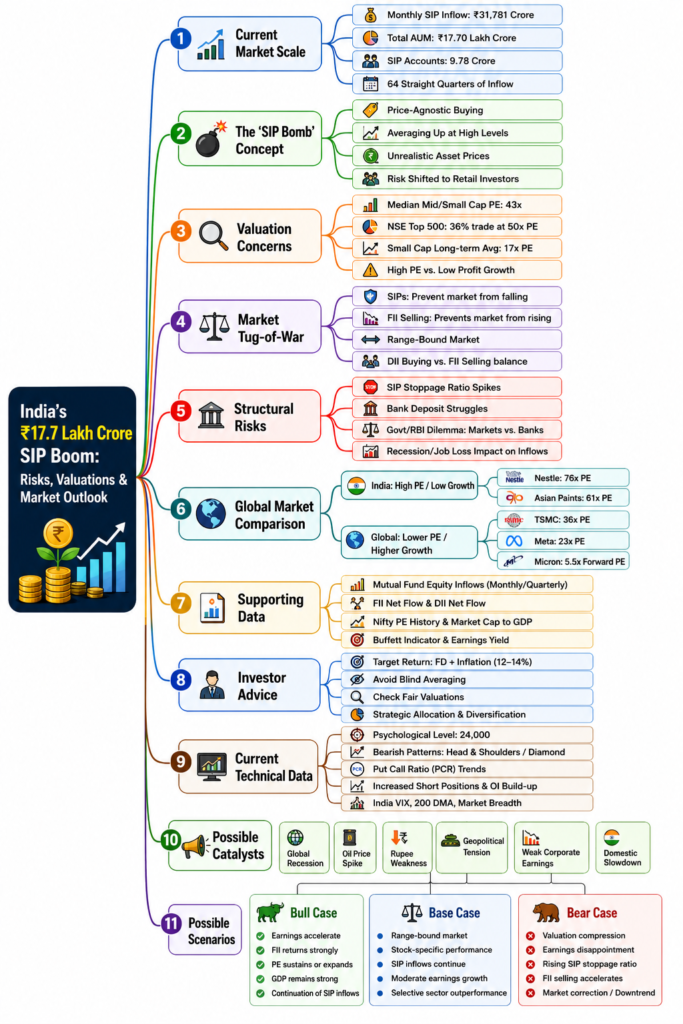
Market Structure Analysis: The SIP Paradox
The Indian equity market has entered a new era where systematic retail money has become one of the biggest market forces.
Every month, over ₹31,781 crore enters equity markets through SIPs, regardless of valuations, news, or market sentiment.
This creates what can be called The SIP Paradox.
Unlike traditional investors who evaluate valuation before investing, SIP flows continue automatically, making them largely price-agnostic.
India’s SIP Machine by the Numbers
| Metric | Latest Figure |
|---|---|
| Monthly SIP Inflow | ₹31,781 Crore |
| SIP AUM | ₹17.70 Lakh Crore |
| Contributing SIP Accounts | 9.78 Crore |
| Consecutive Months of Equity SIP Flows | 64 |
This continuous flow has fundamentally changed Indian market behaviour.
Instead of asking:
“Is this stock worth buying?”
the system automatically asks only:
“Has the monthly SIP date arrived?”
The Valuation Problem: Investors Are Averaging Up
One of the biggest misconceptions surrounding SIP investing is that averaging always reduces risk.
That is only true when markets periodically become undervalued.
Today, many investors are averaging up, not down.
Recent valuation indicators highlight the concern:
- Around 36% of NSE Top-500 companies trade above 50x P/E
- Small-cap forward P/E remains around 28x, versus a long-term average near 17x
- Median Mid & Small-cap valuations have touched historically elevated levels.
In simple words:
Investors are consistently purchasing businesses at increasingly high prices.
While SIPs reduce timing risk, they cannot eliminate valuation risk.
The Market Floor May Be Stronger Than Before—But Not Permanent
Domestic SIP flows have undoubtedly strengthened market resilience.
Large corrections are often cushioned by continuous domestic buying.
However, that creates another structural question.
Who is selling while domestic investors keep buying?
Recent institutional activity shows:
- Domestic Institutional Investors (DIIs): +₹85,800 crore
- Foreign Institutional Investors (FIIs): –₹49,340 crore
In other words,
Indian household savings have increasingly become the counterparty to institutional selling.
That does not automatically mean FIIs are “right.”
It simply reflects different capital allocation decisions.
Global investors continuously compare opportunities across countries.
The Rising SIP Stoppage Ratio Deserves Attention
Another important indicator is the SIP Stoppage Ratio, which measures the number of SIPs discontinued relative to new SIP registrations.
Recent trends have shown a noticeable increase in stoppages.
A rising stoppage ratio may indicate:
- investor fatigue,
- cash-flow pressure,
- disappointing short-term returns,
- or changing household priorities.
One data point does not establish a long-term trend, but sustained increases should be monitored carefully.
SIPs Fixed Several Problems…
The Indian SIP revolution has delivered enormous benefits.
It has:
- Reduced panic selling
- Improved household participation
- Shifted savings from idle assets into productive businesses
- Increased long-term financial discipline
- Helped absorb foreign selling during periods of volatility
Without domestic SIP flows, Indian markets would likely have experienced much sharper corrections in recent years.
…But “SIP at Any Price” Can Create New Problems
The issue is not SIP investing itself.
The issue is buying without considering valuation.
Potential risks include:
- Poor price discovery
- Investors paying excessive valuation multiples
- Lower long-term expected returns
- Greater dependence on continuous inflows
- Retail investors absorbing expensive institutional exits
A useful way to think about it is:
SIPs are an excellent investment tool. Blind investing is not.
India vs Global Opportunity Cost
One of the strongest arguments in today’s market revolves around opportunity cost.
Examples frequently discussed include:
| India | Approx. Valuation |
|---|---|
| Nestlé India | ~76x P/E |
| Asian Paints | ~61x P/E |
| HUL | ~32x P/E |
Compared with:
| Global Leaders | Approx. Valuation |
|---|---|
| TSMC | ~36x P/E |
| Meta Platforms | ~23x Forward P/E |
| Micron Technology | ~5.5x Forward P/E |
The comparison does not imply Indian companies are inferior.
Rather, it highlights that investors should compare price paid versus future earnings potential, regardless of geography.
Final Verdict
The SIP revolution has transformed India’s capital markets and created one of the strongest domestic liquidity bases in history.
But investors should avoid confusing a disciplined investing method with a guarantee of high returns.
The lesson is simple:
SIP is not the problem. “SIP at any price” is.
Long-term wealth creation still depends on three timeless principles:
- Buy quality businesses.
- Respect valuations.
- Stay invested with discipline.
Is tarah ye section aapke original article ke saath naturally merge ho jayega aur screenshots mein dikhaye gaye concepts ko bhi cover karega.
High CTR SEO Titles
- India’s ₹17.7 Lakh Crore SIP Boom: The Hidden Risk Every Investor Must Know
- Are SIP Investors Becoming Exit Liquidity for FIIs? India’s ₹17.7 Lakh Crore Reality
- The SIP Bubble? Why India’s ₹17.7 Lakh Crore Mutual Fund Boom Could Face a Reality Check
- India’s SIP Revolution Explained: Hidden Risks Behind ₹17.7 Lakh Crore in Mutual Funds.
- Is India’s SIP Craze Creating a Stock Market Bubble? The Truth Behind ₹17.7 Lakh Crore
- Why FIIs Are Selling While Indians Keep Buying: The ₹17.7 Lakh Crore SIP Story
- India’s SIP Boom vs FII Selling: Who Will Win the Battle for the Stock Market?
- The Great SIP Illusion: Is Retail Money Keeping India’s Stock Market Alive?
- India’s ₹17.7 Lakh Crore SIP Machine: Opportunity or Market Time Bomb?
- The Dark Side of India’s SIP Boom: Are You Investing or Providing Exit Liquidity?