
Imagine watching the Indian market and seeing completely different stories playing out at the same time.
One part of the market is responding to falling crude oil and easing geopolitical concerns. Another is worrying about US policy toward Indian technology companies. Meanwhile, Nifty is struggling to establish a decisive trend.
This isn’t necessarily a contradiction.
It is what happens when sector-specific catalysts become stronger than the broader market direction.
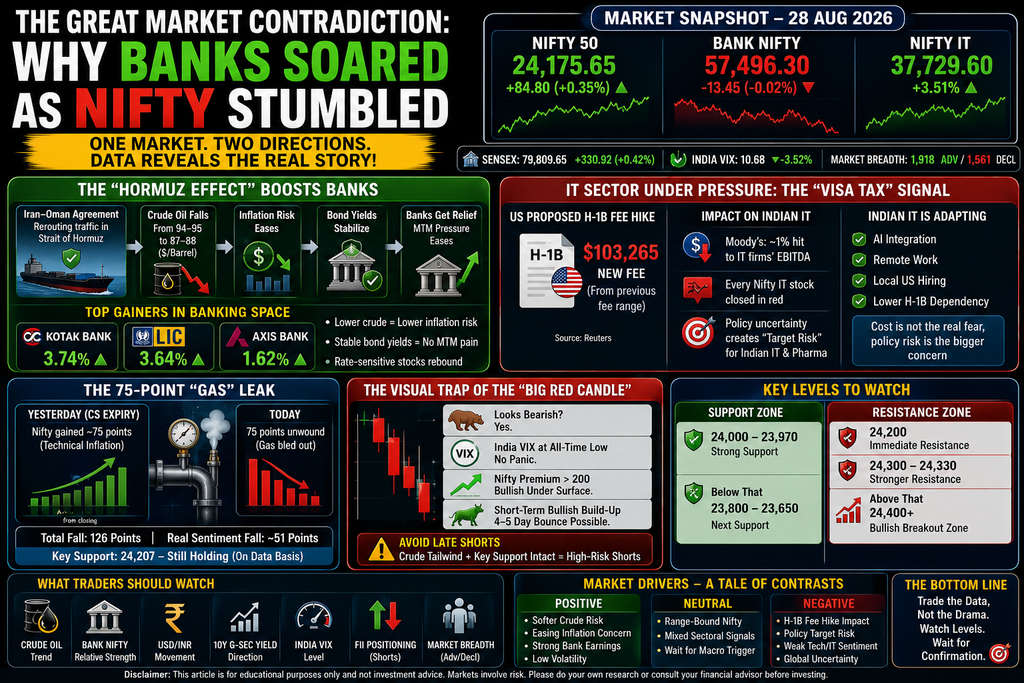
The latest session illustrates the point. On August 28, the Nifty 50 gained 84.80 points, or 0.35%, to close at 24,175.65, while the Sensex gained 330.92 points. Nifty IT jumped 3.51%, whereas Nifty Bank was almost unchanged at 57,496.30.
At the same time, the Nifty remained inside a relatively narrow trading range. The weekly outlook published after the session identified 24,000–23,970 as an important support zone and 24,300–24,330 as near-term resistance.
The real question, therefore, isn’t simply:
“Will Nifty go up or down?”
It is:
“Which sector is going to provide the next major directional impulse?”
1. The Crude Oil Factor: Why Every Trader Is Watching Hormuz
The Strait of Hormuz remains one of the most important variables for Indian markets.
Recent discussions between Iran and Oman have focused on creating a temporary maritime corridor and managing shipping through the Strait of Hormuz. The proposed arrangement includes navigational and mine-clearing measures, although significant uncertainty remains.
For financial markets, even the possibility of smoother shipping can reduce the geopolitical risk premium in crude.
And that matters enormously for India.
The chain reaction is simple:
Hormuz risk ↓
→ crude risk ↓
→ India’s import bill pressure ↓
→ inflation risk ↓
→ bond-yield pressure ↓
→ rate-sensitive sectors get relief
This is why crude oil isn’t just an energy-market variable for Indian investors.
It is a macro variable affecting banks, airlines, chemicals, paints, logistics, consumer companies and the rupee.
2. Why Lower Crude Can Help Banks
Banks don’t benefit from lower crude directly.
They benefit through the second-order effects.
If crude prices fall:
- Imported inflation pressure can ease
- Bond yields may stabilise
- Interest-rate expectations can improve
- Government securities may face less selling pressure
- Corporate borrowing conditions can become more predictable
- Credit demand can remain healthier
That can improve sentiment toward financial stocks.
This is especially important because banks hold substantial fixed-income portfolios.
The bond-price equation
Bond yield ↑ → Bond price ↓
Bond yield ↓ → Bond price ↑
Therefore, when crude creates inflation fears and bond yields rise sharply, banks can face pressure through treasury portfolios and future funding costs.
When that pressure reverses, banking stocks can experience a relief rally.
3. But Don’t Confuse a Relief Rally With a New Bull Market
This distinction is extremely important.
A fall in crude can create a short-term risk-on trade without changing the long-term trend.
That’s why traders should monitor:
Crude + USD/INR + 10Y G-Sec + Bank Nifty
together.
If crude falls but the rupee continues weakening and bond yields remain elevated, the banking rally may not have enough fuel.
But if all four variables improve simultaneously, the probability of a more sustainable banking rebound increases.
4. The IT Story: H-1B Is More Than a Cost Problem
While crude and geopolitical developments influence banks, US immigration policy has become an important variable for Indian IT stocks.
The Trump administration has proposed a $103,265 fee for new H-1B visa applications, a dramatic increase from the previous fee range. Legal challenges and policy uncertainty remain around the proposal.
India’s technology industry body Nasscom has pushed the US government to consider the benefits of H-1B workers and has pointed out that Indian IT companies have already significantly reduced their dependence on H-1B workers by increasing local US hiring.
This creates two separate issues.
Direct impact
Higher visa costs could increase labour costs for companies using the H-1B route.
Indirect impact
The bigger concern is whether H-1B restrictions become part of a broader policy environment that makes Indian IT services less attractive.
That’s the reason investors should distinguish between:
“₹ cost impact”
and
“policy-risk premium.”
The second could matter more over time.
5. Why the IT Sector Can Still Recover
There is an important counterargument.
Indian IT companies aren’t standing still.
They have been increasing:
- Local US hiring
- Offshore delivery
- Automation
- AI adoption
- Cloud services
- Consulting
- High-value digital services
Nasscom also highlighted more than $1.1 billion of investment by Indian IT companies into the US STEM talent pipeline through partnerships and worker upskilling.
Therefore, the H-1B issue should not automatically be interpreted as:
“Indian IT earnings will collapse.”
The better interpretation is:
“The cost structure and delivery model of Indian IT may need to evolve faster.”
6. The Big Red Candle Can Be Misleading
One of the biggest mistakes retail traders make is judging market strength purely by the size of a candle.
A 100–150 point Nifty decline looks frightening.
But the candle itself doesn’t tell us:
- Whether FII shorts increased
- Whether put writing remained strong
- Whether VIX increased
- Whether Bank Nifty outperformed
- Whether breadth deteriorated
- Whether futures premium collapsed
- Whether the fall was caused by expiry adjustments
This is why price + derivatives + breadth + volatility should be analysed together.
7. The “75-Point Gas Leak” Theory Needs a Derivatives Explanation
The original thesis describes a previous-session 75-point “technical inflation” being unwound.
That is a useful trading hypothesis, but it should not be treated as a universally measurable “artificial gain.”
Expiry-day price movements can be influenced by:
- Futures settlement
- Option gamma
- Large OI concentration
- Closing-auction activity
- Index rebalancing
- Short covering
- Long unwinding
So instead of saying:
“75 points were fake.”
A more accurate market interpretation is:
“Part of the previous move may have been expiry-related positioning rather than fresh directional demand.”
That distinction makes the analysis much stronger.
8. India VIX Is Sending an Important Signal
The latest data provides an interesting clue.
India VIX fell to 10.68 on August 28, down about 3.52% during the session, according to HDFC Securities’ market report.
Another weekly market assessment noted that India VIX declined 4.64% to 10.68, indicating relatively subdued expectations of large near-term price swings.
That means the market is not behaving like a panic market.
This is important.
If Nifty falls while VIX remains extremely subdued, it can indicate:
Position adjustment/rotation/consolidation
rather than:
Full-scale institutional panic.
But traders should remember:
Low VIX does not guarantee a rally.
Volatility can rise very quickly once a major catalyst appears.
9. Nifty Is Still Trapped in a Range
This is probably the most important technical point.
The latest weekly data shows Nifty trading inside a relatively narrow range, with the week ending around 24,175.65. Technical analysts identified:
Support
24,000–23,970
Below that:
23,800–23,650
Resistance
24,200
followed by:
24,300–24,400
This gives traders a very simple framework.
Above 24,300–24,400
Momentum can improve.
Between 24,000–24,300
Range trading remains dominant.
Below 23,970
Bearish pressure can accelerate.
This is far more useful than predicting an exact Nifty target.
10. The Bank Nifty Is the Market’s Real Confirmation Indicator
For the coming sessions, traders should watch Bank Nifty relative strength closely.
Why?
Because financials have enormous influence on the broader Nifty.
If:
Nifty ↑ + Bank Nifty ↑ + IT ↑
→ broad-based rally
If:
Nifty ↑ + Bank Nifty ↓
→ rally may lack financial confirmation
If:
Nifty ↓ + Bank Nifty ↑
→ sector rotation rather than broad market collapse
If:
Nifty ↓ + Bank Nifty ↓
→ much stronger bearish confirmation
This framework is much more powerful than looking at Nifty alone.
11. The Market Breadth Also Tells a Different Story
On August 28, 1,918 stocks advanced while 1,561 declined on the NSE.
That is important.
Even though the headline index remained relatively subdued, market breadth was positive.
This suggests that the session was not simply:
“Everything is crashing.”
Instead, money was moving between sectors.
That is the essence of the current market contradiction.
Money is rotating.
Not necessarily disappearing.
12. What Is Really Driving the Market?
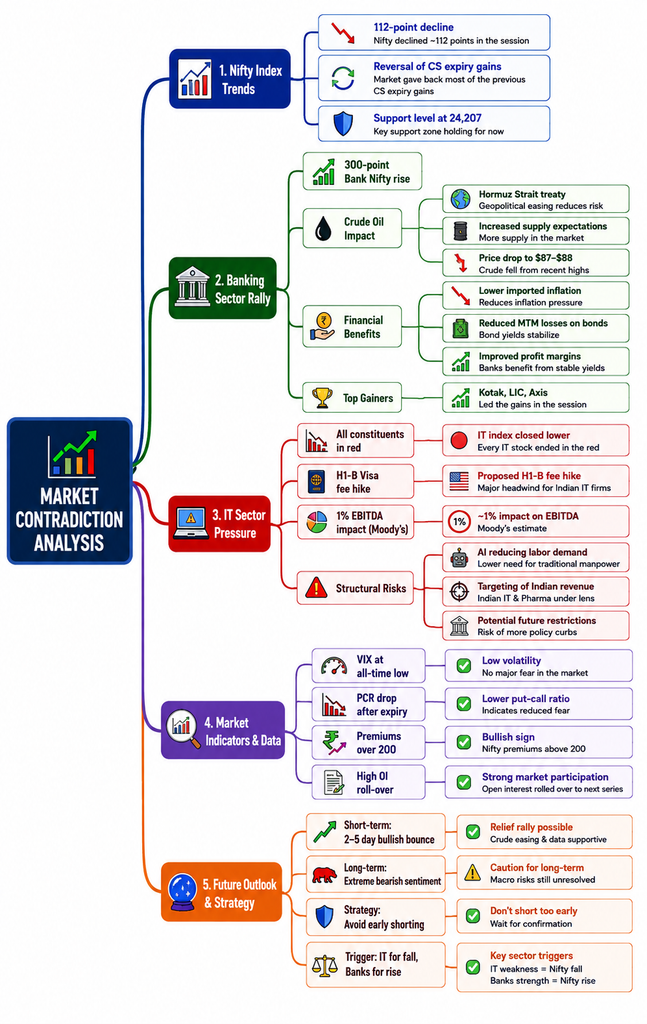
The market currently has five competing forces.
🟢 Positive
1. Softer crude risk
Potentially positive for inflation and financial conditions.
🟢 Positive
2. Strong corporate earnings
Banking earnings remain an important support for valuations.
🟢 Positive
3. Low India VIX
Suggests limited immediate panic.
🔴 Negative
4. US policy risk for Indian IT
H-1B uncertainty creates a valuation overhang.
🔴 Negative
5. Weak technical structure
Nifty remains below important short-term moving averages and needs a breakout above resistance to improve its setup.
13. The Real Trading Setup
Instead of blindly buying or shorting, traders can use a confirmation framework.
🟢 Bullish Setup
Watch for:
- Nifty sustains above 24,300
- Bank Nifty begins outperforming
- Crude remains contained
- India VIX stays below major stress levels
- Market breadth improves
- Put writing increases
- Futures premium improves
That combination would indicate that buyers are gaining control.
🔴 Bearish Setup
Watch for:
- Nifty breaks 23,970
- Bank Nifty underperforms
- Crude rebounds sharply
- USD/INR weakens
- India VIX rises
- Call OI builds near resistance
- Put OI starts unwinding
That would create a much stronger bearish setup.
14. The Biggest Mistake: Shorting After the Fall
The original thesis correctly highlights one important behavioural trap:
Don’t automatically chase a large red candle.
When a market has already fallen sharply, the risk-reward of initiating a fresh short can deteriorate.
Why?
Because:
Short covering + support + low VIX + falling crude
can create a very fast rebound.
That doesn’t mean “buy every dip.”
It means:
Wait for confirmation rather than reacting emotionally to the candle.
15. What Investors Should Watch Next
The next directional move in Nifty is likely to depend on a combination of:
| Factor | Bullish for Market | Bearish for Market |
|---|---|---|
| Crude Oil | Sustained decline | Sharp rebound |
| Bank Nifty | Outperformance | Underperformance |
| India VIX | Remains subdued | Sharp rise |
| USD/INR | Rupee stabilises | Sharp depreciation |
| Nifty | Breaks 24,300–24,400 | Breaks 23,970 |
| IT | H-1B fears fade | Policy pressure intensifies |
| FII Positioning | Shorts reduce | Shorts increase |
| Market Breadth | Advances dominate | Declines dominate |
Conclusion: The Market Doesn’t Have One Story
The Indian market isn’t currently moving according to one simple narrative.
It is being pulled in several directions simultaneously.
Crude oil is influencing inflation and banks.
Hormuz developments are influencing energy risk.
H-1B policy is influencing IT valuations.
India VIX is suggesting that panic is still limited.
Bank Nifty is determining whether financial stocks can provide leadership.
And Nifty 24,000–24,400 remains the critical battlefield.
The latest session reinforces this idea: Nifty closed at 24,175.65, while IT outperformed strongly and Bank Nifty remained almost flat.
So the market’s real message is not:
“Bulls are winning.”
or
“Bears are winning.”
It is:
“Capital is rotating while investors wait for a stronger macro trigger.”
And that makes the next breakout extremely important.
Above 24,400 → bullish confirmation
Below 23,970 → bearish confirmation
Between them → trade the range, not the emotion.
The smartest trader isn’t the one who predicts the next candle.
It is the one who waits until the data confirms the direction.
Disclaimer
This article is for educational and informational purposes only and does not constitute investment advice. Market levels, derivatives positioning, crude oil prices, geopolitical developments, and volatility can change rapidly. Investors should conduct independent research and consult a SEBI-registered financial professional before making investment decisions.
SEO Titles — Top 10
- Nifty 50 Outlook: Why Banks, IT and Crude Oil Are Pulling the Market Apart
- Nifty 50 Today: 5 Key Signals That Could Decide the Next Market Move
- Indian Stock Market Outlook: Banks Rise While Nifty Struggles—What’s Happening?
- Bank Nifty vs Nifty 50: Why the Market Is Showing a Major Contradiction
- Nifty 50 at a Crossroads: Crude Oil, Banks, IT and Key Levels Explained
- Why Bank Stocks Are Rising While Nifty Struggles: The Hidden Market Signals
- Nifty 50 Forecast: Crude Oil, H-1B Risk and Bank Strength to Watch This Week
- Indian Market Rally or Trap? 7 Signals Traders Should Watch Before Taking a Trade
- Nifty 50 Near 24,000: Why Banks, IT and Crude Oil Could Decide the Next Move
- Nifty 50 Trading Strategy: Key Support, Resistance and Market Triggers Explained