
Introduction: The Debt Number Everyone Should Be Watching
India’s external debt has entered a new territory.
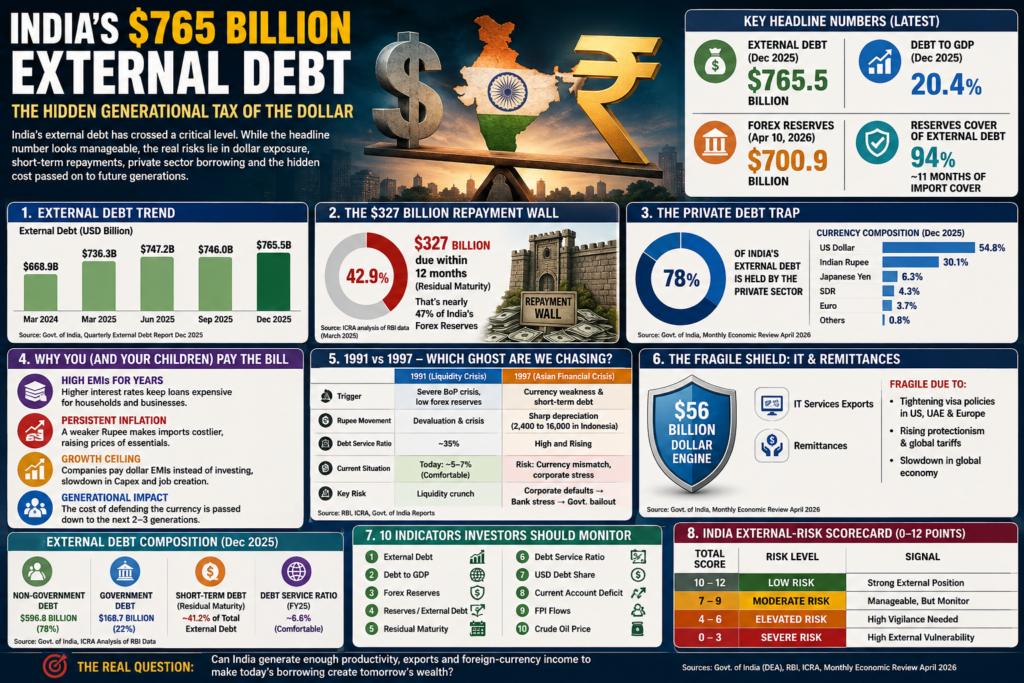
At the end of December 2025, India’s external debt stood at approximately $765.5 billion, according to the Government of India’s quarterly external debt report. That was up from $747.2 billion at the end of September 2025. The external-debt-to-GDP ratio also increased to 20.4%.
At first glance, the number looks alarming.
But the real question is not:
“Is $765 billion of debt too much?”
The more important question is:
“How much of this debt has to be serviced in foreign currency, who owes it, when does it mature, and how strong is India’s dollar-earning capacity?”
That distinction matters because external debt is very different from domestic rupee debt.
A company borrowing ₹1,000 crore domestically does not face the same currency risk as a company borrowing $1 billion from overseas.
If the rupee falls sharply, the second company’s repayment burden rises in rupee terms.
This is where India’s external debt story becomes important for investors.
1. India’s External Debt: The Latest Numbers
The headline number has risen substantially over the past few years.
| Period | External Debt |
|---|---|
| March 2024 | ~$668.9B |
| March 2025 | ~$736.3B |
| June 2025 | ~$747.2B |
| September 2025 | ~$746B |
| December 2025 | ~$765.5B |
At end-March 2025, external debt had increased by $67.5 billion, or roughly 10.1%, from the previous year. The FY25 increase was partly affected by currency valuation changes; excluding the valuation effect, the increase would have been larger at about $72.9 billion.
By December 2025, the debt stock had risen further to $765.5 billion.
The trend matters
The important observation is not simply that debt is high.
It is that external debt has been rising faster than India’s economy for parts of this period, pushing the debt-to-GDP ratio higher.
2. But Is India Actually in a Debt Crisis?
Not necessarily.
This is where sensational headlines can become misleading.
India has a major advantage:
Foreign-exchange reserves.
As of April 10, 2026, India’s foreign-exchange reserves were around $700.9 billion, providing roughly 11 months of import cover and covering approximately 94% of external debt outstanding at end-December 2025.
That is a substantial buffer.
In other words:
$765.5B external debt
versus
~$700.9B forex reserves
does not mean India needs to immediately repay $765.5 billion.
External debt has different maturities, borrowers, currencies and repayment schedules.
This distinction is critical.
3. The Real Risk: Residual Maturity
The headline debt number is less important than when the debt becomes payable.
There are two different concepts:
Original maturity
How long the loan was initially contracted for.
Residual maturity
How much time remains before repayment is actually due.
For financial stability, residual maturity can be more useful.
At end-March 2025, short-term debt on a residual-maturity basis was around 41.2% of total external debt, according to ICRA’s analysis of RBI data.
That means a large portion of India’s external obligations could come due within a relatively short period when measured by remaining maturity.
But there is an important nuance:
Maturing debt does not mean India must pay it entirely from forex reserves.
Companies and financial institutions can refinance, roll over or replace maturing liabilities.
Therefore, the real stress scenario occurs when:
Refinancing becomes expensive + capital inflows weaken + rupee falls + export earnings slow simultaneously.
That is the combination investors should monitor.
4. Who Actually Owes India’s External Debt?
This is one of the most misunderstood parts of the story.
External debt is not simply government debt.
At end-December 2025, the non-government sector accounted for approximately 78% of total external debt, equivalent to around $596.8 billion. Government external debt was around $168.7 billion.
That changes the interpretation completely.
Simplified structure
| Borrower | Approx. Position |
|---|---|
| Non-government sector | ~$596.8B |
| Government | ~$168.7B |
| Total | ~$765.5B |
Therefore, saying:
“India has borrowed $765 billion”
is technically incomplete.
A large portion represents liabilities of Indian companies, banks and other non-government entities to non-residents.
5. The Private-Sector Currency Trap
This is where the risk becomes more interesting.
Imagine an Indian company:
- Revenue: ₹10,000 crore
- External borrowing: $1 billion
- Exchange rate when borrowed: ₹83/$
The rupee value of the principal is approximately:
$1B × ₹83 = ₹8,300 crore
Now imagine the rupee moves to ₹96/$.
The same $1 billion liability becomes:
$1B × ₹96 = ₹9,600 crore
The company has not borrowed another dollar.
But its rupee-equivalent liability has increased by:
₹1,300 crore
This is the currency mismatch problem.
Companies that naturally earn dollars—such as exporters and IT companies—have some natural protection.
Companies earning primarily in rupees while borrowing heavily in dollars have greater exposure.
6. The Dollar Is Still the Dominant Currency
The currency composition of India’s external debt is one of the most important data points.
At end-December 2025:
| Currency | Approx. Share |
|---|---|
| US Dollar | 54.8% |
| Indian Rupee | 30.1% |
| Japanese Yen | 6.3% |
| SDR | 4.3% |
| Euro | 3.7% |
| Others | ~0.8% |
The US dollar remains overwhelmingly the largest foreign-currency component.
This creates a simple macro relationship:
Rupee depreciation → higher rupee cost of servicing dollar liabilities
But there is another side.
A weaker rupee can also increase the rupee value of India’s dollar earnings from:
- IT exports
- Business services
- Merchandise exports
- Remittances
- Overseas income
Therefore, depreciation is not automatically disastrous.
The impact depends on who earns dollars and who owes dollars.
7. India’s $765 Billion Is Not the Same as Sovereign Debt
This distinction deserves its own section.
India’s external debt includes:
- Government borrowing
- Commercial borrowings
- NRI deposits
- Trade credit
- Bank liabilities
- Corporate external borrowing
- Other financial-sector liabilities
Therefore, comparing India’s external debt directly with countries that have very different debt structures can produce misleading conclusions.
The Government of India’s external debt position remains much smaller than the country’s overall external debt stock because a substantial share belongs to private and financial-sector borrowers.
This is one reason why the headline “$765 billion debt crisis” needs to be treated carefully.
8. The Debt-Service Ratio Is the Real Stress Indicator
If you want to know whether a country can actually service its external debt, one useful metric is:
Debt Service Ratio
Debt Service ÷ Current Receipts × 100
At end-March 2025, India’s debt-service ratio was approximately 6.6%, according to ICRA’s analysis of RBI data.
Compare that with India’s historical experience.
In 1991, India’s debt-service ratio was approximately 35%.
That was a completely different situation.
The RBI’s historical data show how dramatically India’s external vulnerability has changed since the 1991 crisis.
1991 vs Today
| Indicator | 1991 | Recent |
|---|---|---|
| External Debt | ~$83.8B | ~$736–765B |
| Debt/GDP | 28.3% | ~19–20% |
| Debt Service Ratio | 35.3% | ~6%–7% |
| Forex Buffer | Very weak | Very substantial |
The absolute debt number is dramatically larger today.
But India’s ability to service that debt is also dramatically stronger.
9. Why 1991 Is Not a Perfect Comparison
India’s 1991 crisis was fundamentally different.
India faced:
- Extremely low forex reserves
- High external vulnerability
- Large short-term obligations
- Weak external financing capacity
- Balance-of-payments stress
- Severe confidence problems
Today, India has:
- Much larger forex reserves
- A substantially lower debt-service burden
- A larger and more diversified economy
- Stronger services exports
- Large remittance inflows
- A deeper domestic financial system
Therefore:
$765B today ≠ 1991 crisis.
The comparison is useful only for understanding what can happen when foreign-currency liquidity disappears.
10. The Real “Hidden Tax” Is Currency Risk
The phrase “generational tax” should not be interpreted literally as a direct tax imposed on future generations.
It is better understood as an economic transmission mechanism.
Suppose the rupee weakens because:
- Oil prices rise
- Capital inflows fall
- Global investors move into dollars
- Trade deficits widen
- Geopolitical risk increases
Then imported goods become more expensive.
India imports large quantities of:
- Crude oil
- Electronics
- Machinery
- Chemicals
- Industrial components
- Gold
A weaker rupee can therefore raise the domestic cost of imported goods.
That can affect:
Household inflation
Imported inflation can eventually affect consumer prices.
Corporate margins
Companies dependent on imported inputs may face higher costs.
Investment
Companies with foreign-currency liabilities may have to spend more cash on debt service.
Household borrowing
The RBI’s monetary response to inflation and currency instability can influence domestic borrowing conditions.
This is the more realistic meaning of the “hidden tax.”
11. But There Is One Major Misconception About RBI Interest Rates
It is tempting to say:
“India must keep interest rates high because of external debt.”
That is too simplistic.
The RBI’s monetary policy is based on a broader set of objectives, including:
- Inflation
- Growth
- Financial stability
- Liquidity
- Currency-market conditions
- External-sector risks
The RBI can also intervene directly in foreign-exchange markets.
For example, the central bank has used spot and forward-market operations to manage disorderly currency volatility.
Therefore:
External debt is one macro risk—not the sole reason for interest-rate policy.
12. The $700 Billion Forex Shield
India’s forex reserves are the country’s first major external defence line.
As of April 10, 2026:
Forex reserves: ~$700.9B
The Economic Division reported that these reserves provided roughly 11 months of import cover and covered around 94% of external debt outstanding at end-December 2025.
This is a significant buffer.
But reserves are not designed simply to repay every external liability.
Their functions include:
- Supporting external liquidity
- Meeting import requirements
- Managing excessive currency volatility
- Maintaining market confidence
- Absorbing external shocks
So the relevant question is:
How quickly are reserves changing relative to external liabilities?
13. The $56 Billion Dollar Engine Is Too Narrow a Description
The original thesis that India depends on a “$56 billion engine” of IT and remittances is too narrow.
India’s external resilience comes from several sources:
1. IT and business services
India is one of the world’s largest exporters of technology and business services.
2. Remittances
India remains one of the world’s largest recipients of remittances.
3. Merchandise exports
Engineering goods, chemicals, pharmaceuticals, electronics and petroleum products contribute to dollar earnings.
4. Foreign investment
FDI and portfolio flows help finance external requirements.
5. NRI deposits
NRI deposits are another source of foreign-currency funding.
The broader lesson is:
India’s ability to service external liabilities depends on its entire balance of payments—not just IT exports.
14. The Current Account Is Another Key Variable
India traditionally runs a merchandise trade deficit because it imports more goods than it exports.
But services and transfers provide an important offset.
For FY2025, India’s current-account deficit was approximately $23.3 billion, or 0.6% of GDP.
That is relatively manageable.
This is important because a country’s external vulnerability depends heavily on whether it can generate enough current receipts to meet external obligations.
Simplified equation
Goods exports + Services exports + Remittances + Other receipts
must be compared with
Imports + External debt service + Other external payments.
The larger and more stable the first side, the safer the external position.
15. Why the Rupee Matters More Than the Headline Debt
Suppose external debt stays at:
$765B
but the rupee moves from:
₹85 → ₹100/$
The dollar debt has not changed.
But the rupee-equivalent value of the liability rises sharply.
That is why currency risk can become a silent balance-sheet problem.
Simple illustration
$765B × ₹85 = approximately ₹65 lakh crore
$765B × ₹100 = approximately ₹76.5 lakh crore
The difference is enormous.
This does not mean India suddenly owes ₹11.5 lakh crore more in cash.
It illustrates the importance of exchange-rate translation.
For investors, this is especially relevant when analysing companies with large foreign-currency borrowings.
16. Who Is Most Vulnerable?
Investors should watch companies with the following combination:
High foreign debt
Low natural dollar revenue
Weak hedging
Low operating margins
Short maturity profile
This combination can become dangerous during a sharp rupee depreciation.
On the other hand, companies with:
- Strong dollar revenues
- Natural hedges
- Long-duration debt
- Strong cash flow
- Low leverage
may actually benefit from a weaker rupee.
17. The Corporate Currency Stress Test
Investors can perform a simple stress test.
For every company with foreign debt, calculate:
Step 1
Foreign Debt / EBITDA
Step 2
Foreign Currency Debt / Total Debt
Step 3
Dollar Revenue / Dollar Debt
Step 4
Hedged Debt / Total Foreign Debt
Step 5
Stress test at:
- ₹90/$
- ₹95/$
- ₹100/$
- ₹105/$
Then estimate:
Additional rupee liability + additional interest expense
This can reveal risks that a normal P/E ratio completely misses.
18. The NHAI “Shadow Debt” Argument Needs Caution
Infrastructure-related liabilities are often cited as hidden sovereign debt.
But investors need to distinguish between:
Government external debt
Public-sector enterprise liabilities
Guaranteed liabilities
PPP/project liabilities
Domestic borrowing
External borrowing
Not every liability outside the central government’s headline debt is automatically a sovereign obligation.
Therefore, claims that NHAI liabilities are simply “hidden external debt” should be treated carefully unless a specific liability is legally or economically attributable to the sovereign.
The better framework is:
Look at contingent liabilities and guarantees separately from India’s official external debt.
19. What Could Trigger a Genuine External-Sector Problem?
The biggest risk is not one variable.
It is a combination.
Scenario 1 — Oil Shock
Crude oil prices surge.
↓
India’s import bill rises.
↓
Trade deficit widens.
↓
Dollar demand increases.
↓
Rupee comes under pressure.
Scenario 2 — Capital-Flow Shock
Global investors move money into US assets.
↓
FPI outflows increase.
↓
Dollar strengthens.
↓
Rupee weakens.
↓
Refinancing becomes more expensive.
Scenario 3 — Corporate Default Cycle
Rupee falls sharply.
↓
Unhedged foreign debt becomes expensive.
↓
Corporate cash flows deteriorate.
↓
Defaults increase.
↓
Banks face credit stress.
This third scenario is the one investors should watch most carefully.
20. India’s Strongest Defence: Domestic-Currency Financing
One reason India is structurally safer than countries that borrowed heavily in foreign currency is the depth of its domestic rupee financing market.
A large amount of government borrowing is in domestic currency.
That matters because the government is not exposed to the same direct foreign-currency repayment risk on every rupee-denominated liability.
This creates an important distinction:
Domestic debt
Primarily interest-rate and fiscal risk.
External foreign-currency debt
Interest-rate + refinancing + currency risk.
The second category is generally more dangerous during a currency crisis.
21. What Investors Should Monitor in 2026
Instead of watching only the headline external-debt number, track these 10 indicators:
| Indicator | Why It Matters |
|---|---|
| External Debt | Overall external liability |
| Debt/GDP | Relative economic burden |
| Forex Reserves | Liquidity buffer |
| Reserves/External Debt | External protection |
| Residual Maturity | Near-term repayment pressure |
| Debt-Service Ratio | Ability to service debt |
| USD Debt Share | Currency exposure |
| Current Account Deficit | Dollar funding requirement |
| FPI Flows | Capital-flow pressure |
| Crude Oil Price | India’s import-dollar requirement |
This is a much better dashboard than simply reading:
“$765 billion external debt.”
22. The Investor’s India External-Risk Scorecard
For a simple macro framework, investors can score each factor from 0–2.
1. Forex Reserves
2: Strong coverage
1: Moderate
0: Rapid deterioration
2. Debt Service
2: Stable/low
1: Rising
0: Severe deterioration
3. Current Account
2: Comfortable
1: Moderate deficit
0: Large persistent deficit
4. Currency
2: Stable
1: Gradual depreciation
0: Disorderly depreciation
5. Capital Flows
2: Strong inflows
1: Mixed
0: Persistent outflows
6. Corporate FX Risk
2: Strong hedging/natural exports
1: Moderate
0: Significant unhedged exposure
Interpretation
| Score | Macro Signal |
|---|---|
| 10–12 | Strong external position |
| 7–9 | Manageable but monitor |
| 4–6 | Elevated risk |
| 0–3 | Severe external vulnerability |
This is not a formal sovereign credit rating. It is a research framework.
23. What Could Actually Become a “Generational Tax”?
The real danger is not simply a large external-debt number.
The danger is a chain reaction:
More foreign borrowing
↓
Rupee depreciation
↓
Higher repayment cost
↓
Higher corporate financial stress
↓
Lower investment
↓
Lower productivity
↓
Slower wage growth
↓
Higher imported inflation
↓
Lower household purchasing power
That is the real economic transmission mechanism.
If borrowing finances productive assets that generate future exports and income, debt can be beneficial.
If borrowing finances consumption without creating future foreign-exchange earnings, the risk is much higher.
24. Debt Is Not Always Bad
This is perhaps the most important conclusion.
A country can borrow externally and become stronger.
Suppose India borrows $100 billion to build:
- Semiconductor plants
- Export factories
- Ports
- Renewable-energy infrastructure
- Technology infrastructure
- High-value manufacturing
Those assets can generate future dollar earnings.
Then:
Debt → Investment → Productivity → Exports → Dollar earnings → Debt repayment
That is a healthy cycle.
But if borrowing creates:
Debt → Consumption → Imports → Currency pressure → More borrowing
the cycle becomes dangerous.
Therefore, the quality of borrowing matters more than the headline number.
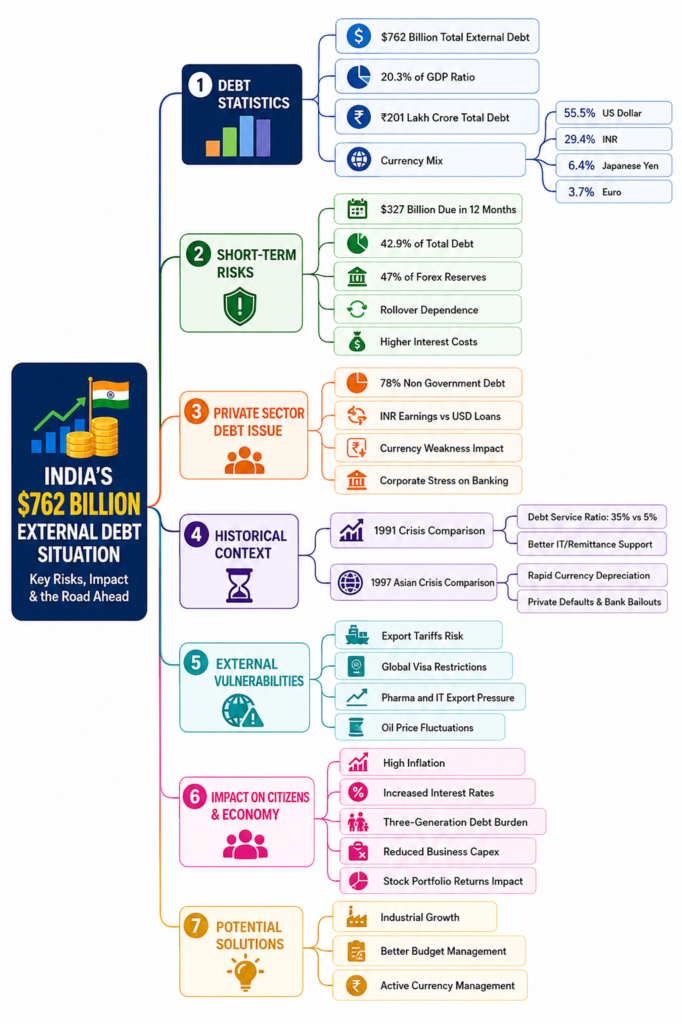
25. Final Verdict: $765 Billion Is a Warning Signal, Not a Crisis Signal
India’s external debt story deserves serious attention.
But calling it an immediate 1991-style crisis would be an exaggeration.
The latest available data show:
- External debt around $765.5 billion
- External debt/GDP around 20.4%
- Non-government debt around 78%
- US dollar share around 54.8%
- Forex reserves around $700.9 billion as of April 2026
- Roughly 11 months of import cover
- Debt-service burden around 6–7% in the latest FY25 data
These numbers tell a more nuanced story.
India is not sitting on the edge of a 1991-style external crisis.
But the country does have a growing currency and refinancing sensitivity.
The most important risk is not:
“India owes $765 billion.”
It is:
“How much of that debt must be refinanced, in what currency, by whom, and against how much dollar-earning capacity?”
That is the question sophisticated investors should ask.
26. The Bigger Investment Lesson
For an Indian investor, external debt matters through several channels.
For banks
Watch foreign-currency exposure, corporate defaults and asset quality.
For infrastructure companies
Watch external commercial borrowings and currency hedging.
For IT companies
A weaker rupee can increase the rupee value of dollar revenues.
For oil-importing companies
A weaker rupee can increase input costs.
For exporters
Currency depreciation can improve competitiveness.
For the equity market
A sharp currency shock can trigger:
FPI outflows → higher volatility → valuation compression.
Therefore, India’s external debt is not just a government statistic.
It can eventually influence:
Rupee → inflation → interest rates → corporate earnings → Nifty valuations.
Conclusion: The Debt Number Is Not the Story—The Dollar Flow Is
India’s external debt has grown dramatically in absolute terms.
But the country is also much larger, richer in foreign-exchange reserves and more capable of generating foreign-currency income than it was in 1991.
The real danger lies in a mismatch:
Dollar liabilities growing faster than reliable dollar earnings.
That is why investors should stop looking at external debt as a single number.
Watch the entire chain:
External Debt
↓
Residual Maturity
↓
Forex Reserves
↓
Dollar Exposure
↓
Current Account
↓
Capital Flows
↓
Rupee
↓
Corporate Balance Sheets
↓
Nifty & Investor Returns
The question for India’s next decade is therefore not:
“Can India repay $765 billion?”
It is:
“Can India generate enough productivity, exports and foreign-currency income to make today’s borrowing create tomorrow’s wealth?”
If the answer is yes, external borrowing can become a growth engine.
If the answer is no, the cost may eventually appear not as a single tax bill—but through a weaker rupee, higher import costs, lower corporate investment and reduced purchasing power.
That is the real hidden economic tax investors need to watch.
Key Data Sources
- Government of India, Department of Economic Affairs — Quarterly External Debt Report: external debt of $765.5B at end-December 2025 and 20.4% debt-to-GDP.
- Government of India’s Monthly Economic Review, April 2026: non-government share, currency composition and forex-reserve coverage.
- Government of India, External Debt Report 2024–25: FY25 external debt of $736.3B, $67.5B annual increase and 19.1% debt-to-GDP.
- RBI historical external-debt data: long-term comparison of India’s external vulnerability and 1991 debt-service conditions.
- ICRA analysis of RBI data: FY25 debt-service ratio and residual-maturity indicators.
Investor Disclaimer
This article is for educational and macroeconomic research purposes only. External debt, currency movements, forex reserves and capital flows can change rapidly. The scenarios discussed above are analytical frameworks, not predictions or investment recommendations. Investors should independently evaluate company-level foreign-currency exposure, hedging, debt maturity, cash flow, valuation and risk before making investment decisions.
Top 10 SEO titles:
- India’s $765 Billion External Debt: Is the Rupee Facing a Hidden Generational Tax?
- India External Debt 2026: $765 Billion Debt, Rupee Risk & Forex Reserves Explained
- India’s $765 Billion External Debt: Should Investors Be Worried?
- India External Debt Crisis? The $765 Billion Risk Every Investor Should Understand
- India’s Foreign Debt Hits $765 Billion: Rupee, Forex Reserves & Economic Risk Explained
- $765 Billion India External Debt: The Hidden Risk Behind the Falling Rupee
- India’s External Debt 2026: Dollar Exposure, Forex Reserves & Rupee Risk
- India’s $765 Billion Debt Problem: What It Means for the Rupee and Indian Stocks
- India External Debt Explained: $765 Billion, Dollar Risk & the 1991 Crisis Comparison
- The $765 Billion Question: Is India’s External Debt Becoming a Generational Burden?