
1. Introduction: The Market Is Falling Without Panic
The Indian equity market is currently displaying one of the more deceptive patterns for traders: prices are weakening, but volatility has not yet exploded.
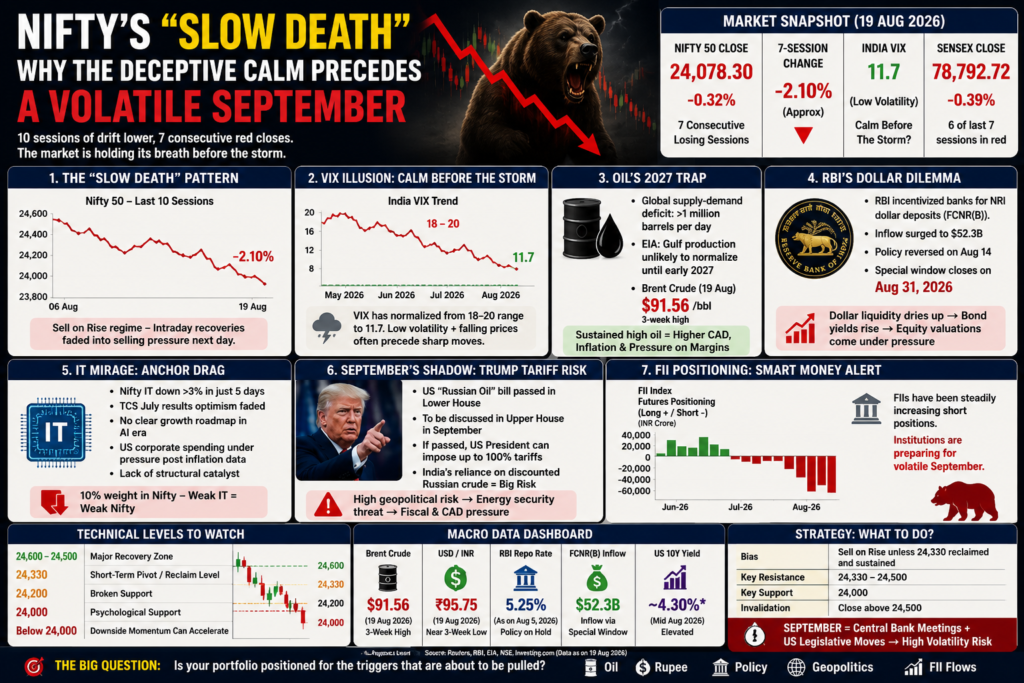
On 19 August 2026, the Nifty 50 closed at 24,078.30, down 0.32%, marking its seventh consecutive losing session and taking the seven-session decline to approximately 2.1%. The Sensex also declined for six of the previous seven sessions.
This is important because a market does not always begin a correction with a dramatic crash.
Sometimes it starts with:
Lower highs → repeated selling on rallies → weak breadth → falling momentum → compressed volatility → sudden expansion.
That is the pattern traders need to watch.
The current environment increasingly resembles a “Sell on Rise” market rather than a clean bullish trend.
However, calling an imminent crash would be premature. The more accurate conclusion is:
Nifty is entering September with a fragile technical structure and several external macro triggers capable of rapidly increasing volatility.
2. Nifty Has Already Broken the 24,200 Zone
The first major technical development is that the market has moved below the 24,200 area highlighted in the original setup.
With Nifty closing at:
24,078.30
the next psychological zone becomes:
24,000
This makes 24,000 an important battleground.
Simplified technical map
| Nifty Level | Interpretation |
|---|---|
| 24,500–24,600 | Major recovery zone |
| 24,330 | Short-term pivot / reclaim level |
| 24,200 | Broken support |
| 24,000 | Psychological support |
| Below 24,000 | Downside momentum can accelerate |
The 24,330 level should be treated as a trading framework rather than a guaranteed reversal point.
If Nifty reclaims 24,330 and sustains above it, bearish pressure can ease.
If the index repeatedly fails below this level, rallies may continue to attract sellers.
3. Seven Consecutive Red Sessions: Why It Matters
A seven-session decline is psychologically important.
But there is an important distinction:
A losing streak does NOT automatically mean “short.”
After multiple consecutive declines, the probability of a technical relief bounce increases.
The problem for bulls is that a relief bounce is different from a trend reversal.
The market can easily move:
24,078 → 24,200 → 24,330
and still resume the broader decline.
Therefore, traders should distinguish between:
Relief Rally
Temporary recovery caused by short covering.
and
Trend Reversal
Higher high + higher low + sustained volume + broader participation.
At present, the second confirmation is still missing.
4. India VIX: The Volatility Illusion
India VIX remains relatively subdued compared with periods of genuine market panic.
Historical data show India VIX around 11.6–12.2 during early-to-mid August.
This creates an interesting contradiction:
Nifty falling
but
VIX not exploding.
That means the market is not yet pricing an extreme panic scenario.
And that is exactly why September could become interesting.
A low VIX does not mean the market cannot fall.
It means option markets are currently pricing relatively modest expected volatility.
If a genuine macro trigger suddenly appears, volatility can reprice very quickly.
The sequence traders should watch:
Low VIX
↓
Nifty weakness
↓
Negative catalyst
↓
VIX expansion
↓
Option premium expansion
↓
Fast directional move
This is why selling naked options simply because VIX is low can be dangerous.
5. The Oil Problem Is Getting Bigger
Oil has become one of the most important variables for Indian markets.
On 19 August, Brent crude traded around $91.56 per barrel, reaching a three-week high as uncertainty surrounding Middle East supply and shipping continued.
India is particularly sensitive because it is one of the world’s largest oil importers.
Higher crude prices can affect:
- Inflation
- Current-account balance
- Rupee
- Government finances
- Corporate margins
- Transportation costs
- Consumer spending
- RBI policy
This creates a dangerous macro chain:
Crude ↑
→ Import bill ↑
→ Dollar demand ↑
→ Rupee pressure ↑
→ Inflation risk ↑
→ Rate-cut expectations ↓
→ Equity valuations ↓
6. The 2027 Oil Story Is More Complicated
The original thesis argues that the world faces a prolonged supply deficit.
The latest IEA data support the idea that the oil market remains highly disrupted, but the precise “over 1 million barrels/day deficit until early 2027” claim should be treated cautiously.
The IEA’s July 2026 outlook said global oil supply had partially recovered, but remained 9.4 million barrels/day below pre-war levels in June, while full recovery depended on de-escalation.
The EIA similarly expects most Middle Eastern production and trade patterns to move toward pre-conflict levels by the end of 2026, with much of shut-in production returning during Q1 2027.
So the better thesis is:
The risk is not necessarily a permanent oil shortage; it is prolonged supply disruption and unusually high uncertainty.
For India, even a temporary period of $90–100+ crude can matter significantly.
7. The Rupee Is Sending Another Warning
The rupee closed around ₹95.75 per US dollar on 19 August, near a three-week low. Reuters reported that rising crude prices and strong dollar demand were contributing to pressure, while RBI intervention was helping prevent a sharper decline toward ₹96.
This creates another market feedback loop:
Crude ↑
→
USD demand ↑
→
INR ↓
→
Imported inflation ↑
→
RBI flexibility ↓
That is why traders should monitor USD/INR and Brent together with Nifty.
A falling Nifty + rising crude + falling rupee is considerably more bearish than a falling Nifty alone.
8. RBI’s FCNR Policy: The August 31 Deadline
One of the biggest liquidity developments is the RBI’s special foreign-currency deposit/swap programme.
The RBI had introduced measures to encourage banks to attract fresh FCNR(B) dollar deposits and strengthen foreign-currency liquidity.
But the response was much stronger than expected.
By August 13, approximately:
$52.3 billion
had been raised through FCNR(B) deposits under the facility.
The RBI therefore decided to close the relevant swap facility one month earlier, on August 31 rather than September 30.
This is a crucial distinction.
The August 31 deadline does not mean:
“$52 billion will suddenly disappear from India.”
Rather, the special incentive window ends.
That means traders should watch whether the marginal supply of dollar liquidity changes after the deadline.
9. RBI Is Already Defending the Rupee
The central bank is not sitting idle.
On August 18, Reuters reported that the RBI was active across multiple FX markets, including:
- Spot
- Exchange-traded futures
- Non-deliverable forwards
to cushion rupee volatility.
This tells us something important.
The RBI appears willing to use its balance sheet to prevent disorderly currency moves.
For equity traders, this can temporarily reduce volatility.
But if crude remains elevated and global yields continue climbing, the RBI may have to balance:
Currency stability
against
Liquidity and growth.
That becomes a difficult policy equation.
10. Bond Yields Are the Silent Pressure
Equity investors often focus almost entirely on Nifty charts.
But bond yields can quietly change the valuation environment.
When global yields rise:
US yields ↑
↓
Dollar assets become more attractive.e
↓
Emerging-market capital faces pressure. re
↓
FPI flows weaken
↓
Equity valuation multiples can compress.
Reuters reported that rising global bond yields were one of the factors weighing on Indian equities on August 19, alongside higher crude prices.
This is why the September setup cannot be analysed using Nifty alone.
A better dashboard is:
Nifty + India VIX + Brent + USD/INR + US 10Y + FII flows
11. RBI Policy Is Also Becoming More Complicated
The RBI kept the repo rate at:
5.25%
at its August 5 meeting.
But the latest meeting minutes showed policymakers becoming more concerned about inflation risks from higher oil prices.
July CPI inflation was reported at 4.45%, while the RBI’s growth forecast was raised to 6.7% and its inflation forecast was around 5%.
This produces an interesting combination:
Growth still relatively strong
but
Inflation risks rising.
For the stock market, that means the probability of aggressive easing becomes lower if crude remains elevated.
12. IT: From Market Leader to Drag?
The IT sector has become another source of uncertainty.
There have been periods this year when Nifty IT strongly outperformed, but the sector has also experienced sharp bouts of selling.
For example, Nifty IT fell more than 3% during the June 19 sell-off, while concerns about global IT spending and weaker guidance affected sentiment.
The current concern is structural:
- AI disruption
- US technology spending
- Wage costs
- Automation
- Pricing pressure
- Weak discretionary spending
- Currency movement
However, IT should not automatically be classified as bearish.
A weaker rupee can actually benefit Indian IT exporters because much of their revenue is dollar-linked.
Therefore:
IT + weak INR
can sometimes become a partial hedge against the broader macro shock.
13. September’s Biggest Geopolitical Risk: Russian Oil
Another major risk is the proposed US legislation targeting Russian energy buyers.
The US Senate overwhelmingly advanced a sanctions bill that could give the President authority to impose tariffs of up to 100% on countries heavily dependent on Russian oil and gas. India and China are specifically among the countries that could face exposure.
But investors should avoid treating this as a guaranteed 100% tariff on India.
The legislation still faces political and legislative hurdles.
Therefore, the correct interpretation is:
Risk ≠ Eventuality
The market may nevertheless price the possibility before the law is finalized.
That is enough to create volatility.
14. Why Russian Oil Matters So Much for India
India has significantly increased its role as a buyer of discounted Russian crude.
The economic benefit is straightforward:
Cheaper crude
→
Lower input cost
→
Better refining economics
→
Lower pressure on the import bill.
But geopolitical restrictions can change that equation.
If Russian crude becomes harder or more expensive to import:
India may need alternative suppliers.
If replacement crude is more expensive:
India’s import bill rises.
That could pressure:
- INR
- Inflation
- CAD
- Oil marketing companies
- Transport costs
- Consumer prices
The irony is that Indian refiners can sometimes benefit from supply disruptions, while the broader economy suffers from higher crude prices. Reuters noted that Indian refiners have benefited from disrupted global supply flows while operating at high utilization.
15. FII Positioning: The Smart-Money Warning
FII positioning should be monitored closely.
A bearish setup becomes more credible when:
Price ↓
FII short exposure ↑
VIX ↑
Put buying ↑
Call writing ↑
USD/INR ↑
Brent ↑
This combination indicates that the decline is not merely technical.
It indicates broader macro hedging.
However, FII short positions alone should never be treated as a guaranteed prediction.
Large institutions use futures and options for:
- Hedging
- Relative-value trades
- Portfolio protection
- Arbitrage
Therefore:
FII short = risk signal, not automatic sell signal.
16. September Liquidity Risk: IPOs Are Another Factor
There is another factor receiving less attention:
Primary-market liquidity.
Reuters reported that a surge in IPOs and institutional placements could absorb a significant amount of available investment capital, potentially affecting liquidity in secondary markets.
This creates an interesting situation.
Even if domestic investors remain bullish:
Money moving into new issues
can temporarily reduce:
Money available for existing stocks.
Therefore,e September could face a combination of:
- Global risk-off
- IPO liquidity absorption
- High crude
- Weak rupee
- Rising yields
- FII hedging
That is a much more important setup than the Nifty chart alone.
17. The “Slow Death” Setup: Five Signals to Watch
The bearish thesis becomes significantly stronger if these five conditions occur simultaneously.
Signal 1 — Nifty below 24,000
A decisive breakdown accompanied by volume would weaken the psychological floor.
Signal 2 — Brent above $95–100
This would increase pressure on India’s inflation and external balance.
Signal 3 — USD/INR approaches or breaks 96
This would indicate increasing currency stress.
Signal 4 — India VIX jumps
A sudden move from suppressed volatility toward higher levels would confirm risk repricing.
Signal 5 — FII shorts increase
This would suggest institutional hedging or bearish positioning is intensifying.
18. The Bullish Reversal Checklist
The opposite scenario is equally important.
Do not become permanently bearish.
A bullish reversal would become more credible if:
Nifty reclaims 24,330
↓
Holds above 24,500
↓
India VIX remains controlled
↓
Brent falls below $85–90
↓
INR stabilizes
↓
FII selling slows
↓
Financials regain leadership
That would invalidate much of the immediate “slow death” thesis.
19. September Scenario Matrix
| Scenario | Nifty Bias | Crude | INR | VIX | Strategy Bias |
|---|---|---|---|---|---|
| Bullish | Above 24,500 | Falls | Stable | Low | Buy dips |
| Neutral | 24,000–24,500 | $85–95 | Range | Moderate | Range trade |
| Bearish | Below 24,000 | >$95 | Weak | Rising | Sell on rise |
| Panic | Sharp breakdown | >$100 | Severe weakness | Spike | Defensive |
This is a scenario framework—not a prediction.
20. What Traders Should Do Now
For short-term traders, the biggest mistake would be:
Chasing puts after seven consecutive red sessions.
The market can produce a sharp short-covering bounce at any time.
A better approach is to wait for confirmation.
Bearish setup
If Nifty:
fails near 24,200–24,330
and forms a lower high,
then bearish trades become more attractive.
Bullish setup
If Nifty:
reclaims 24,330 and sustains
then aggressive shorts should be reconsidered.
Major line in the sand
24,000
A decisive break with volume would materially increase downside risk.
21. Options Traders Need One Extra Warning
When VIX is relatively low, option premiums can look attractive to buyers.
But low premium does not automatically mean a cheap option.
For a trader buying puts:
You need both:
Direction + volatility expansion.
If Nifty falls slowly while VIX remains compressed, the option can still lose value because of:
- Theta decay
- IV changes
- Time decay
- Slow price movement
Therefore, the setup is not simply:
“Nifty bearish → buy PE.”
It is:
“Nifty bearish + technical breakdown + momentum + sufficient time + acceptable premium.”
For a September swing trade, this distinction is extremely important.
22. The Bigger Picture: This Is Not Just a Nifty Story
The current weakness is the result of several variables interacting:
Oil
$91+ Brent
↓
Rupee
~₹95.75/$
↓
RBI
Defending currency
↓
Bonds
Global yields elevated
↓
Foreign Flows
Risk appetite under pressure
↓
Nifty
7 consecutive declines
This is why the market feels weak even without a single catastrophic event.
23. Final Verdict: Calm, But Not Comfortable
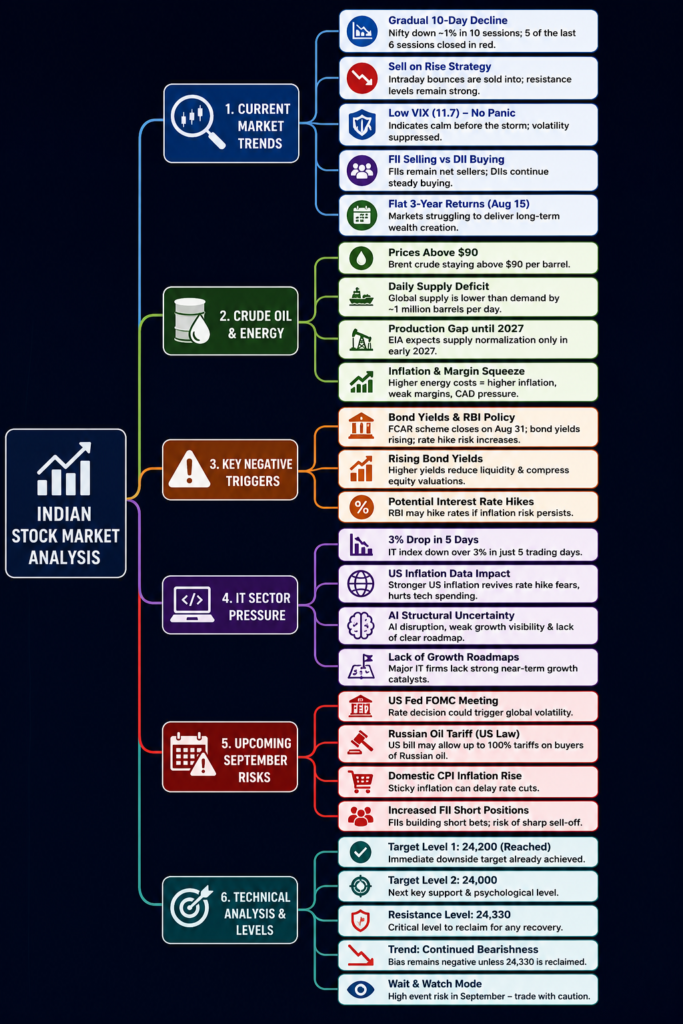
The phrase “Slow Death” captures the psychology of the current market, but investors should not interpret it as a guaranteed crash call.
The data currently show something more subtle:
- Nifty has fallen for seven consecutive sessions
- The index has lost about 2.1% over that period
- Nifty closed at 24,078.30
- Brent is around $91.56
- USD/INR is around ₹95.75
- RBI is actively managing currency volatility
- India VIX remains relatively subdued
- RBI’s FCNR(B) special swap window closes August 31
- A US-Russia sanctions bill carries a potential 100% tariff threat
- Global bond yields remain a pressure point.
None of these guarantees a September crash.
But together, they create a market where volatility can rise very quickly if another negative catalyst arrives.
The key levels remain simple:
24,500 → Bullish recovery zone
24,330 → Short-term pivot
24,200 → Broken support
24,000 → Major psychological support
The market’s next major signal will therefore not be another red candle.
It will be what happens when Nifty reaches 24,000.
If buyers defend it and breadth improves, the “slow death” thesis weakens.
If 24,000 breaks with rising VIX, crude above $95, rupee weakness and expanding FII shorts, September could become significantly more volatile.
The market is not necessarily predicting a crash. It is telling us that the margin for error is becoming smaller.
For investors, September is therefore not about predicting one number. It is about watching the interaction between Nifty, crude, the rupee, bond yields, VIX and foreign flows.
Sources
The current-market figures above are based primarily on Reuters reporting and official/primary-source market and policy information, including the RBI and IEA/EIA.
Disclaimer: This is market research and scenario analysis, not a guaranteed forecast or personalized investment advice.