
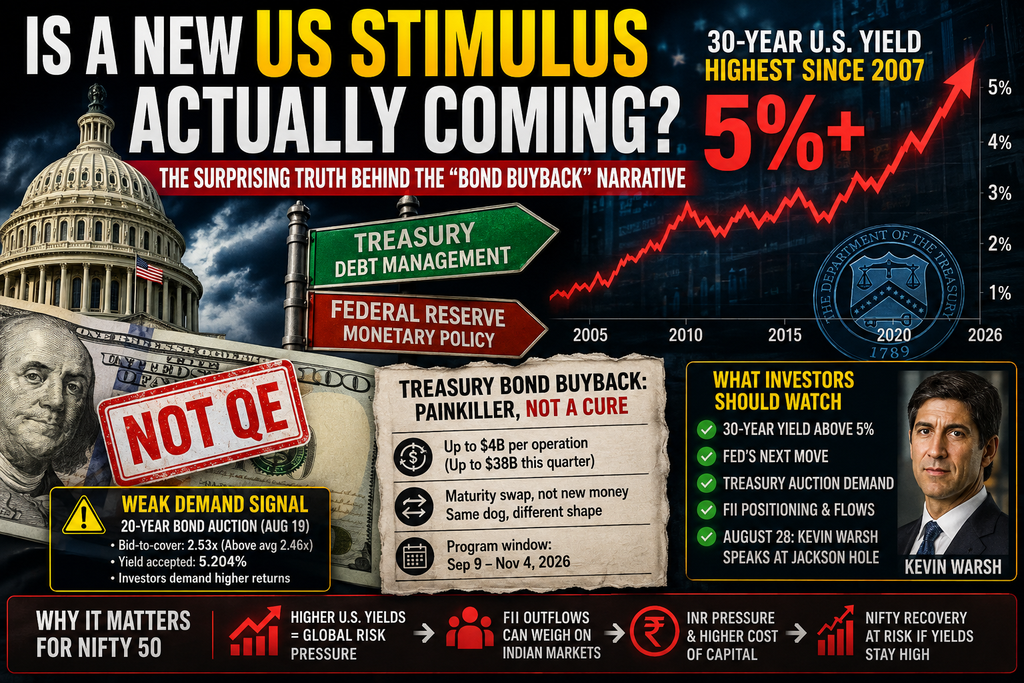
Is a New US Stimulus Actually Coming?
Global equity markets are currently trying to look past one of the biggest warning signals in the fixed-income market: U.S. long-term Treasury yields above 5%.
The 30-year U.S. Treasury yield climbed to around 5.34% during the week, reaching its highest level since 2007. On August 21, it remained around 5.28%, keeping pressure on global risk assets.
At the same time, a new narrative has spread through financial markets:
“The U.S. government has restarted the money printer.”
That interpretation is too simplistic.
What Washington has actually done is expand a Treasury bond buyback operation designed to improve liquidity and manage pressure in the long end of the Treasury market.
That is very different from a traditional Federal Reserve Quantitative Easing program.
And that distinction matters enormously for investors in equities, bonds, gold, the dollar and emerging markets such as India.
1. Treasury Buyback ≠ Federal Reserve QE
The first misconception is confusing the U.S. Treasury Department with the Federal Reserve.
The Treasury manages government borrowing and debt maturity. The Federal Reserve controls monetary policy and can expand or contract its balance sheet through monetary operations.
The recent move came from the Treasury, not from a newly announced Fed QE program.
The Treasury announced that it would double the maximum size of certain liquidity-support buybacks for longer-dated Treasury securities, with the change taking effect between September 9 and November 4, 2026.
So calling this “QE” is misleading.
The difference is simple:
| Traditional QE | Treasury Buyback |
|---|---|
| Conducted by Federal Reserve | Conducted by Treasury |
| Monetary-policy tool | Debt-management/liquidity tool |
| Fed expands its balance sheet | Treasury manages outstanding securities |
| Can inject central-bank reserves | Does not automatically represent new Fed-created reserves |
| Designed primarily to ease financial conditions | Designed to improve Treasury-market liquidity and manage debt |
This does not mean the Treasury operation is irrelevant.
It means investors should understand what type of intervention it actually is.
2. The Real Problem: The Long End of the Bond Market
The biggest warning signal is not the headline about the buyback.
It is the behavior of long-term yields.
The 30-year Treasury yield moved above 5.3% during the recent selloff, reaching levels not seen since 2007.
Why does that matter?
Because long-term Treasury yields influence almost everything:
- Mortgage rates
- Corporate borrowing costs
- Government interest expenses
- Equity valuations
- Technology stock valuations
- Private-equity financing
- AI infrastructure financing
- Emerging-market capital flows
- Dollar and bond-market expectations
A 5%+ long-term risk-free yield creates a much higher hurdle for equities.
If an investor can receive approximately 5% from a long-duration U.S. government security, speculative assets have to offer a much stronger expected return to remain attractive.
That is particularly important for high-duration technology and AI stocks.
Reuters noted that the recent bond-market selloff is being driven by concerns around inflation, fiscal stability and the enormous amount of U.S. government debt that needs to be financed.
3. This Is Not a $4 Billion “Stimulus”
This is where the online narrative becomes exaggerated.
The headline figure of $4 billion needs context.
The Treasury is not saying:
“We are injecting $4 billion into the global financial system.”
Rather, the Treasury increased the maximum purchase size for certain buyback operations to up to $4 billion per operation.
The operation is part of a broader Treasury buyback framework.
For the August–October quarter, Treasury said it anticipates purchasing:
- Up to $38 billion of off-the-run securities for liquidity support
- Up to $25 billion in the 1-month to 2-year maturity bucket for cash-management purposes
Therefore, the correct interpretation is:
This is a meaningful Treasury-market intervention, but it is not equivalent to a new multi-trillion-dollar Federal Reserve QE program.
4. Why Treasury Wants to Support the Long End
The U.S. government is dealing with an enormous financing requirement.
For July–September 2026, the Treasury estimated approximately $739 billion of privately held net marketable borrowing.
For October–December, the estimate was another $628 billion.
That means roughly:
$1.37 trillion of estimated privately held net marketable borrowing
across those two quarters.
This is the bigger story.
The Treasury is not operating in a vacuum.
It needs the market to absorb huge quantities of government debt while investors are simultaneously demanding higher compensation for holding long-duration bonds.
That creates a dangerous feedback loop:
Higher debt issuance → higher required yields → higher government interest expense → greater fiscal pressure → investors demand even higher yields.
That is the real macro problem.
5. The $40 Trillion Debt Problem
The U.S. federal debt has now crossed approximately $40 trillion, according to recent market reporting.
And the issue is not simply the absolute debt number.
The more important question is:
At what interest rate must that debt be refinanced?
When yields remain elevated, refinancing becomes progressively more expensive.
Recent reporting has highlighted that U.S. interest payments have risen above $1 trillion annually.
That creates a structural problem.
The government cannot simply wish long-term yields lower.
It has to convince investors that holding long-term U.S. debt remains sufficiently attractive.
6. The 20-Year Auction: A Warning, But Not a Collapse
One part of the original narrative needs an important correction.
The August 19 Treasury auction involved $16 billion of newly issued 20-year bonds.
The result was not actually evidence of a complete buyer strike.
The auction recorded a 2.53 bid-to-cover ratio, above the historical average of approximately 2.46.
Foreign investors accounted for around 62.9% of purchases, slightly above the historical average of 62.5%.
However, investors demanded a slightly higher yield than the pre-auction level, with the accepted yield at 5.204%.
So the correct conclusion is more nuanced:
Demand exists — but investors are demanding compensation.
That is arguably more important than a simple “weak auction” headline.
The Treasury can support liquidity.
But it cannot permanently force investors to accept unattractive yields.
7. The Market’s Biggest Warning: 30-Year Yield Above 5%
The long-end yield is where investors should focus.
On August 18, the 30-year Treasury yield reached roughly 5.23%, the highest level since 2007. It subsequently pushed above 5.3% during the week’s volatility.
This creates a crucial test.
If Treasury intervention works:
- Long-term yields stabilize
- Bond volatility falls
- Equity risk appetite improves
- Growth stocks get relief
- Emerging markets may benefit
- Nifty could receive a global-risk-on boost
If intervention fails:
- 30-year yield remains above 5%
- Bond prices continue falling
- Financing costs rise
- Equity valuation multiples compress
- AI/high-duration stocks become vulnerable
- Dollar and emerging-market flows become unstable
- FII selling pressure can increase
This is why the bond market may be more important than the stock market over the next few weeks.
8. Why This Matters for Nifty 50
India cannot completely ignore a U.S. Treasury shock.
The transmission mechanism is straightforward:
U.S. yields ↑ → global risk-free rate ↑ → FII risk appetite ↓ → emerging-market capital flows weaken → INR pressure ↑ → Indian equity valuations face pressure.
That does not automatically mean Nifty must crash.
India has domestic liquidity, strong institutional participation and its own economic drivers.
But if U.S. long-term yields continue climbing while the Federal Reserve remains restrictive, the margin of safety for emerging-market equities becomes smaller.
As of August 21, Nifty futures were around 24,288, while the September contract was around 24,394.90 in the cited market snapshot.
The key question is therefore not simply:
“Will Nifty go up?”
The better question is:
Can Nifty continue rising if U.S. long-term yields remain above 5%?
9. FII Positioning Adds Another Layer of Risk
Recent derivatives data also deserves attention.
FII index-futures positioning remained heavily active during the August selloff. Data for August 20 showed FII index-futures net selling of approximately ₹362.7 crore for the day, while the open-interest value remained elevated. Previous sessions also showed sizeable net selling, including approximately ₹2,492.8 crore on August 19 and ₹2,029 crore on August 18.
This does not prove that Nifty must fall.
But it tells us something important:
The rebound should not automatically be interpreted as a complete bearish-trend reversal.
A portion of the equity recovery can come from:
- Short covering
- Position adjustment
- Domestic liquidity
- Options positioning
- Global risk sentiment
- Expectations surrounding U.S. policy
Therefore, traders should watch price + FII positioning + U.S. yields together, rather than relying on Nifty price alone.
10. August 28: The Next Major Macro Catalyst
The next major event is Fed Chair Kevin Warsh’s Jackson Hole speech on August 28.
Warsh is scheduled to speak at the Jackson Hole symposium at 10:00 a.m. ET on August 28.
Markets will be watching for clues about:
- Inflation
- Future interest-rate policy
- September FOMC expectations
- The Fed’s tolerance for higher yields
- Financial-market stability
- Long-term monetary policy
- Whether the Fed is preparing to ease or remain restrictive
This is especially important because markets are already debating the probability of future rate moves.
Reuters reported that markets were assigning meaningful probabilities to a September hike and an even higher probability of a December hike, making Warsh’s communication especially important for global assets.
11. The Bigger Question: Is the Fed Going to Restart QE?
At the moment, investors should be careful with the phrase “money printer restarted.”
A genuine QE regime would normally involve a significant expansion of the Federal Reserve’s balance sheet through purchases of securities.
The Treasury’s buyback program is fundamentally different.
Therefore:
Current situation:
Treasury buyback ≠ Fed QE
But that does not mean the situation is harmless.
If long-term Treasury yields continue rising sharply, financial conditions could deteriorate enough that pressure on policymakers increases.
That is where the real QE discussion could eventually become important.
The market should therefore watch the Fed balance sheet, Treasury yields, financial conditions and actual policy announcements rather than social-media headlines.
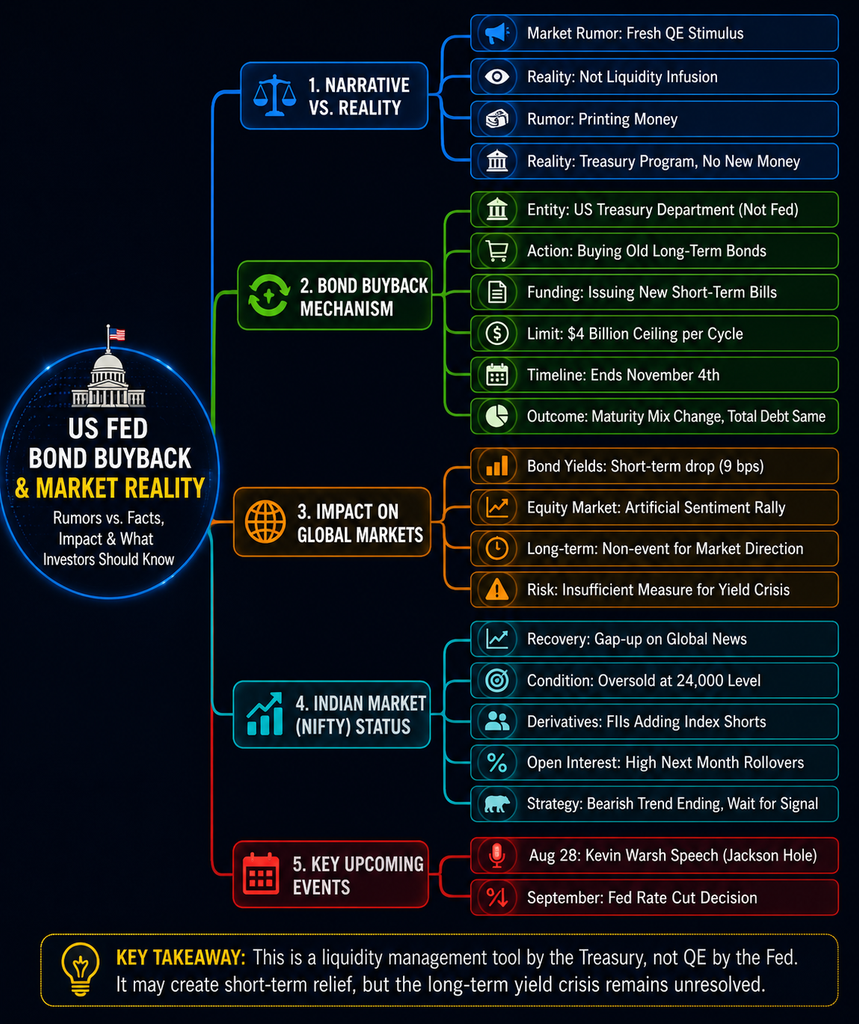
12. Painkiller vs. Cure
The Treasury buyback can be viewed as a painkiller.
It can potentially:
- Improve liquidity
- Support specific Treasury securities
- Reduce market dysfunction
- Smooth volatility
- Temporarily improve sentiment
But it cannot by itself solve:
- Massive fiscal deficits
- Rising debt servicing costs
- Inflation risk
- Structural Treasury supply
- Long-term investor demand
- Geopolitical risk
- Higher global term premiums
That distinction is critical.
A liquidity problem can be treated with liquidity.
A fiscal problem requires fiscal adjustment.
That is why the market’s reaction to Treasury intervention matters so much.
13. What Investors Should Watch Next
The next few weeks could be dominated by five indicators.
1. U.S. 30-Year Treasury Yield
Below 5%: Relief signal.
5%–5.3%: High-risk zone.
Above 5.3% with momentum: Major warning for global risk assets.
2. U.S. 10-Year Treasury Yield
A sustained move toward or above the recent highs would increase pressure on equity valuations.
3. Federal Reserve Communication
Warsh’s August 28 speech could rapidly change rate expectations.
4. Treasury Auction Demand
Watch:
- Bid-to-cover
- Tail
- Foreign participation
- Dealer allocation
- Yield concession
The key question is not simply whether bonds are sold.
It is:
At what yield must the Treasury sell them?
5. FII Index-Futures Positioning
If Nifty rises while FIIs continue building large short positions, the rally may contain a significant short-covering component.
If FII shorts unwind while Nifty breaks resistance, the market structure becomes considerably stronger.
14. Bull Case vs. Bear Case
| Factor | Bullish Scenario | Bearish Scenario |
|---|---|---|
| 30Y Treasury | Falls below 5% | Moves above 5.3% |
| Fed | Dovish | Hawkish |
| Inflation | Cools | Reaccelerates |
| Treasury auctions | Strong demand | Higher yield concessions |
| FII positioning | Shorts unwind | Shorts increase |
| Nifty | Breakout | Rejection |
| AI stocks | Valuation relief | Multiple compression |
| USD/INR | Stable | INR pressure |
| Global liquidity | Improves | Tightens |
Conclusion: Don’t Confuse a Treasury Intervention With a Money Printer
The current U.S. bond-market situation is much more complicated than the headline “new stimulus is coming.”
The Treasury has expanded its bond-buyback operations at a time when the 30-year Treasury yield has climbed above 5.3%, debt has crossed roughly $40 trillion, and the government faces enormous refinancing requirements.
But this is not the same thing as the Federal Reserve launching a new QE program.
The Treasury is attempting to improve liquidity and manage pressure in the bond market.
That may provide temporary relief.
But the bigger test remains:
Can Washington stabilize long-term Treasury yields without creating a much larger fiscal or inflation problem?
That is the question investors should be asking.
And for Indian investors, the answer matters because the path of U.S. yields could influence FII flows, the rupee, technology valuations and ultimately Nifty 50’s ability to sustain its recovery.
August 28 could therefore become a critical macro checkpoint.
If Kevin Warsh delivers a dovish message and Treasury yields fall, global equities could receive another relief rally.
But if Warsh remains hawkish while the 30-year Treasury yield stays above 5%, the current equity rebound could prove much more fragile than it appears.
The real “money printer” test has not happened yet.
The bond market is still watching.
And so should Nifty investors.
Data Sources & Verification
Key figures in this article were cross-checked against recent U.S. Treasury releases, Reuters reporting, and current Treasury-market data. Treasury’s August 2026 refunding documents confirm the planned buyback scale, while Reuters and other market reports document the recent surge in long-term Treasury yields.
Disclaimer: This article is for informational and educational purposes only and should not be treated as investment advice.
Best SEO pick:
- Is a New US Stimulus Coming? The Truth Behind the Treasury Bond Buyback
- US Bond Buyback 2026: Is Washington Secretly Restarting the Money Printer?
- US Treasury Bond Buyback Explained: Why This Is NOT New QE
- US Debt Crisis 2026: The Bond Buyback, 5% Yields & Nifty Risk
- Is the Fed Restarting QE? The Shocking Truth About the US Bond Market
- US Treasury Yield Crisis: What the 5% Bond Yield Means for Nifty 50
- US Stimulus or Bond Market Rescue? The $4 Billion Buyback Explained
- Why US Treasury Yields Above 5% Could Threaten Global Stock Markets
- Nifty 50 Warning: How the US Bond Crisis Could Trigger FII Selling
- US Bond Market Crisis 2026: Treasury Buyback, Fed QE & Nifty 50 Outlook