
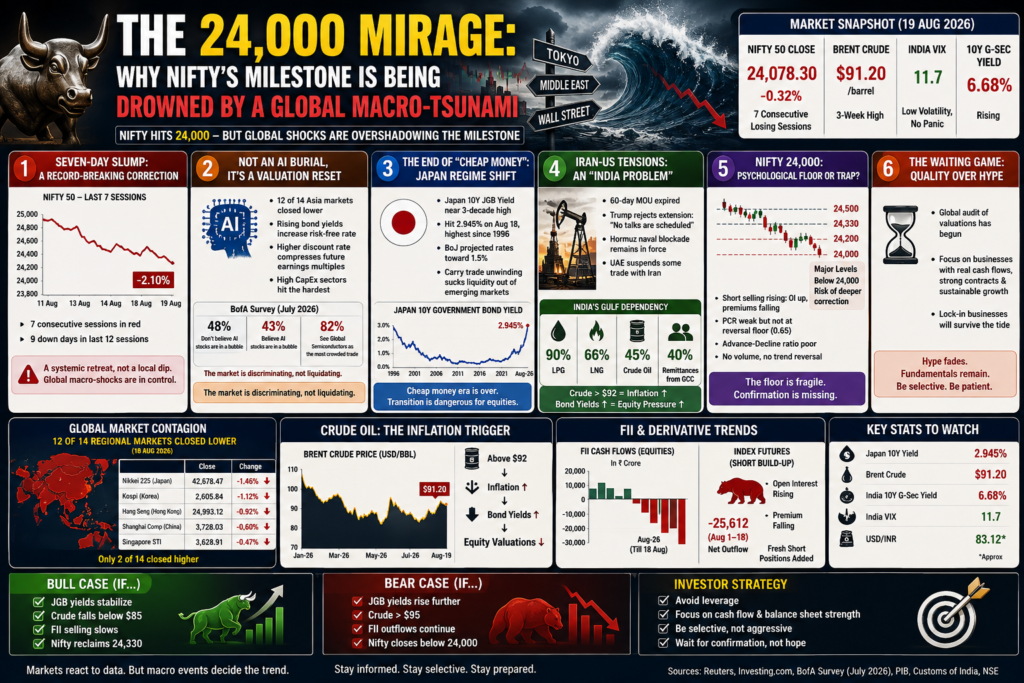
The Nifty 50’s move around the 24,000 mark is increasingly looking less like a stable floor and more like a battleground between domestic buyers and powerful global macro forces.
Three developments deserve particular attention: Japan’s rapidly rising bond yields, Middle East energy risks and the repricing of expensive growth stocks.
The latest market data makes the Japan story particularly important. India’s benchmark is facing pressure at the same time that Japan’s 10-year government bond yield has approached 3%, reaching 2.945% on August 18, its highest level since 1996.
That matters because Japan has historically been one of the world’s cheapest funding markets.
When that funding regime changes, global capital flows can change with it.
1. Nifty 24,000: Psychological Support or False Comfort?
The 24,000 level has become an important psychological reference point for traders.
But investors should avoid treating a round number as automatic support.
The more important question is:
Will institutional buyers defend 24,000 with volume and breadth?
Recent market action has shown persistent weakness. On August 18, the Nifty recorded its sixth consecutive losing session, while Brent crude remained above $90 and global bond yields climbed.
This combination is particularly uncomfortable for Indian equities because:
Higher oil → higher inflation risk → higher yields → lower equity valuations.
Therefore, 24,000 can hold temporarily while the underlying market remains bearish.
Key technical framework
| Level | Significance |
|---|---|
| 24,500 | Major recovery zone |
| 24,330–24,350 | Near-term resistance |
| 24,200 | Important pivot |
| 24,000 | Psychological support |
| Below 24,000 | Risk of further downside |
The important signal isn’t simply whether Nifty touches 24,000.
It is whether it closes below it with expanding volume and weak market breadth.
2. Japan’s Bond Shock: The Hidden Global Risk
This may be the most underappreciated part of the current market story.
Japan’s 10-year JGB yield reached 2.945% on August 18, while the 30-year yield moved above 4%. Reuters reported that markets are increasingly concerned about inflation, Japan’s fiscal position, and the possibility of further Bank of Japan tightening.
This is significant because Japan spent decades operating under extremely low interest rates.
That created an enormous incentive for investors to:
- Borrow cheaply in yen.
- Convert the money into other currencies.
- Buy higher-yielding assets.
- Earn the interest-rate differential.
This is commonly known as the yen carry trade.
If Japanese yields rise substantially, that calculation changes.
The danger
Suppose an investor previously borrowed yen at a very low cost.
If Japanese rates rise while the yen strengthens, the investor can face:
Higher funding cost + currency loss + falling foreign asset prices.
That can encourage investors to unwind positions.
For emerging markets such as India, this creates an additional source of volatility.
3. The 3% JGB Threshold Is More Than a Number
Japan’s 10-year yield approaching 3% is not just another bond-market statistic.
Reuters described the move as the highest level since 1996.
The broader global bond market is also experiencing pressure. Major economies have seen borrowing costs rise amid persistent inflation concerns and geopolitical risks.
This creates a valuation problem for equities.
Why?
Stock valuation models discount future earnings using interest rates.
When the risk-free rate rises:
Present value of future profits ↓
Therefore, companies whose valuations depend heavily on earnings far into the future can experience the biggest multiple compression.
This is particularly relevant to:
- Technology
- Semiconductors
- AI infrastructure
- High-growth companies
- Highly leveraged businesses
4. The AI Bubble Debate Is More Complicated
The recent weakness in technology stocks has revived the question:
Is the AI boom becoming an AI bubble?
The answer isn’t straightforward.
Bank of America’s July Global Fund Manager Survey showed that 48% of fund managers did not believe AI stocks were in a bubble, while 43% believed they were. Meanwhile, 82% identified global semiconductor longs as the most crowded trade.
That distinction is important.
The market isn’t necessarily saying:
“AI is dead.”
Instead, investors may be asking:
“Are today’s AI valuations justified by tomorrow’s earnings?”
That’s a completely different question.
The AI valuation equation
AI investment ↑
but
Required return ↑
then:
Valuation multiple ↓
unless:
Future earnings growth ↑ enough to compensate.
This is why rising bond yields can hurt technology stocks even when the underlying AI business remains strong.
5. Why Iran and the Middle East Matter to Nifty
India remains highly sensitive to energy prices because it is a major importer of crude oil and other energy products.
But one important nuance should be added to the original article:
India has already demonstrated significant ability to reroute energy supplies away from the Strait of Hormuz.
The Indian government’s March briefing said around 70% of India’s crude imports were then being routed outside Hormuz. It also said India imports about 60% of its LPG consumption, with roughly 90% of those LPG imports coming through Hormuz.
Subsequent customs data showed further diversification. By May 2026, only about 25% of India’s crude imports by value came from suppliers inside the Strait, compared with 48% in 2025.
This means the risk isn’t simply:
“Hormuz closes = India runs out of oil.”
The bigger risk is:
Hormuz disruption → global crude premium → higher Indian import bill → inflation pressure → margin pressure → higher bond yields → lower equity valuations.
That’s a much more realistic transmission mechanism.
6. Russia Has Become an Important Shock Absorber
Another major change is India’s increasing use of Russian crude.
According to customs data reported in July, Russia’s share of India’s crude imports rose from around 19% in January to 43% in May, worth approximately $8.1 billion in May alone.
This diversification has provided India with an important buffer.
But it doesn’t eliminate the risk.
If geopolitical restrictions significantly disrupt Russian oil flows, India could face simultaneous pressure from:
- Higher crude prices
- Higher freight costs
- Higher insurance costs
- Rupee pressure
- Higher inflation
That’s why crude oil remains one of the most important variables for the Nifty.
7. The Crude Oil → Nifty Transmission Channel
For investors, the relationship can be simplified:
Oil ↑
↓
India’s import bill ↑
↓
Current-account pressure ↑
↓
Rupee pressure ↑
↓
Inflation expectations ↑
↓
Bond yields ↑
↓
Equity valuation ↓
↓
Nifty pressure
The effect isn’t always immediate, but sustained energy inflation can become a serious macro headwind.
This is particularly important for sectors with weak pricing power.
8. The Market Is Not Only About Oil
A common mistake is to blame every Nifty decline on geopolitical tensions.
The current setup is more complicated.
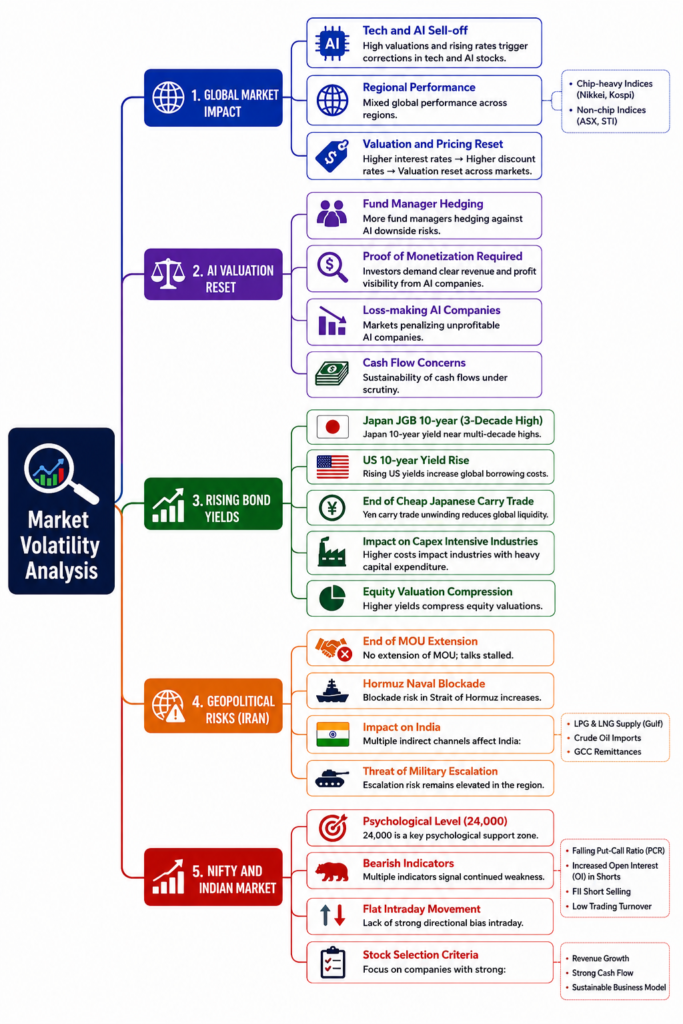
There are at least five simultaneous macro variables:
1. Japan
Rising JGB yields and potential monetary tightening.
2. Middle East
Geopolitical risk and crude-oil uncertainty.
3. Global Bonds
Higher yields are pressuring expensive equity valuations.
4. AI/Technology
Investors increasingly want evidence of monetization rather than unlimited future growth.
5. Foreign Flows
Global portfolio allocation can shift rapidly when risk-free returns increase elsewhere.
This is why the current correction should be viewed as a macro repricing event, not simply a technical Nifty correction.
9. Nifty 24,000: What Traders Should Watch Next
The most important thing now is confirmation.
Bullish scenario
If Nifty:
24,000 holds → 24,200 reclaimed → 24,330 breaks → 24,500
then the current correction could develop into a relief rally.
Bearish scenario
If Nifty:
24,000 breaks decisively → weak breadth → rising volume → fresh short OI
then the psychological support becomes resistance.
The next downside zones would need to be evaluated dynamically rather than assuming that 24,000 is an absolute floor.
10. The Real Signal: Price + Volume + Breadth
A single indicator is not enough in a macro-driven market.
I would monitor these five variables together:
| Indicator | Bullish Signal | Bearish Signal |
|---|---|---|
| Nifty | Above 24,200 | Below 24,000 |
| India VIX | Stable/falling | Sharp rise |
| Market Breadth | Improving | More declines |
| FII Positioning | Short covering | Fresh shorts |
| Crude | Falling | Sustained >$90 |
| JGB Yield | Stabilizing | Further rise |
| Bond Yields | Falling | Rising |
This gives a much better picture than watching the Nifty level alone.
11. What Investors Should Do
This isn’t necessarily a market where investors should panic.
It is a market where position sizing matters more than prediction.
Long-term investors should focus on businesses with:
- Strong free cash flow
- Low debt
- Pricing power
- High return on capital
- Stable domestic demand
- Sustainable earnings growth
Short-term traders should avoid assuming that every dip is automatically a buying opportunity.
The difference between:
“Nifty is down 5%, therefore buy”
and
“Nifty is down 5%, but the macro trend has stabilized”
can be enormous.
Conclusion: 24,000 Is a Number—Macro Is the Real Story
The Nifty’s 24,000 milestone may look like a major technical event, but the bigger story is happening outside India.
Japan’s 10-year yield is approaching 3%, crude remains elevated, global borrowing costs are rising,g and investors are reassessing the valuation of high-growth technology stocks.
At the same time, India’s energy-import structure has become more diversified, reducing—but not eliminating—the direct risk from a disruption around Hormuz.
So the real question isn’t:
“Will Nifty hold 24,000?”
The better question is:
“Will global liquidity, oil prices and bond yields stabilize enough for Nifty to build a sustainable bottom?”
Until that answer becomes clearer, 24,000 should be treated as a decision zone—not a guaranteed floor.
Disclaimer: This article is for market education and analysis, not a recommendation to buy or sell securities.
Top 10 SEO Titles
- Nifty 24,000 Mirage: Why Japan Bond Yields, Oil and Global Risks Threaten Indian Stocks
- Nifty 24,000 Under Pressure: Japan’s Bond Shock and Iran Tensions Explained
- Nifty 50 Outlook: Is 24,000 a Strong Support or a Dangerous Trap?
- Why Nifty Is Struggling Near 24,000: Oil, Japan and Global Market Risks
- Nifty 24,000 Breakdown? 5 Global Risks Every Indian Investor Should Watch
- Nifty 50 Crash Risk: How Rising Japan Bond Yields and Crude Oil Could Hit India
- Nifty 24,000 Support Explained: What Japan, Oil and FII Flows Mean for Investors
- Indian Stock Market Outlook: Why Nifty 24,000 Could Be a Mirage
- Nifty 50 Today: Japan Yield Shock, Crude Oil and Iran Tensions Raise Market Risk
- Nifty 24,000 at Risk? The Global Macro Tsunami Behind India’s Market Correction