
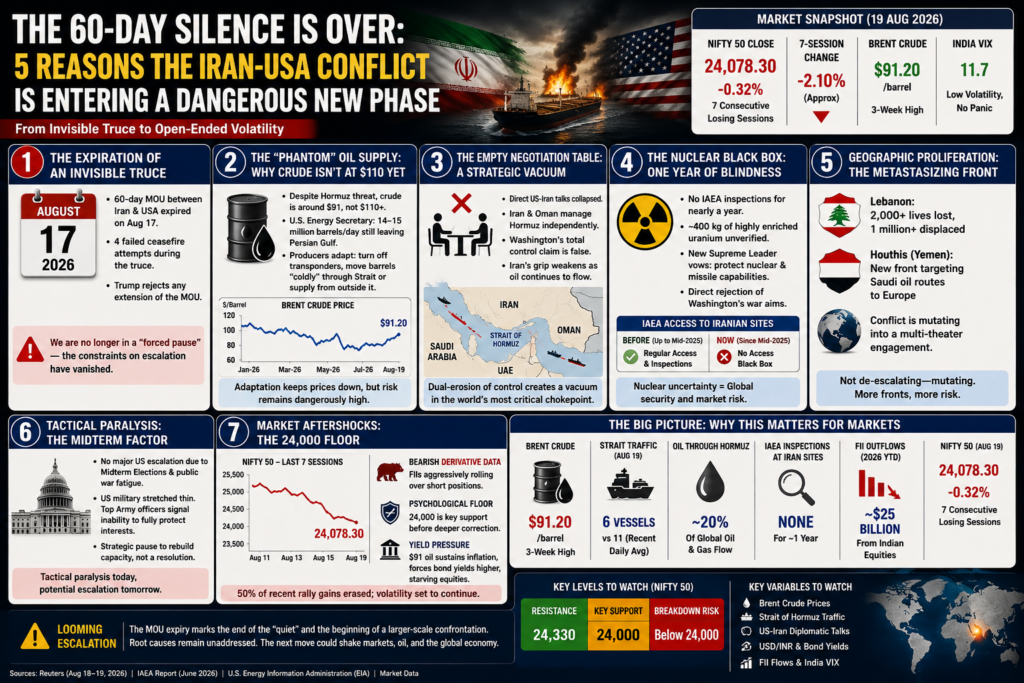
1. The 60-Day Silence Is Over
For roughly two months, markets were operating under the assumption that Washington and Tehran still had a diplomatic off-ramp.
That assumption has weakened dramatically.
The temporary framework expired without a durable settlement, while the United States and Iran remain divided over sanctions, military activity and—most importantly—the Strait of Hormuz.
On August 18, President Donald Trump said there were no current or planned talks with Iran, while Tehran maintained that the Strait remained closed until its conditions were met.
This creates a fundamentally different market environment:
The question is no longer simply whether the conflict ends. The question is whether the next phase becomes more confrontational or returns to negotiations.
And financial markets hate this kind of uncertainty.
2. Why the Strait of Hormuz Is the Real Trump Card
The most important geographic feature in this conflict is not Tehran.
It is Hormuz.
The Strait of Hormuz normally carries roughly one-fifth of global oil and gas shipments. But current vessel traffic has fallen sharply because shipping companies are reluctant to take the risk.
Reuters reported that only six commodity vessels passed through the Strait on Tuesday, compared with nine the previous day and a recent average of about 11 daily transits.
That is a huge change for a waterway that normally handles an enormous share of global energy trade.
The market equation is simple:
Hormuz disruption
↓
Shipping risk
↓
Lower effective oil supply
↓
Higher crude prices
↓
Inflation
↓
Higher bond yields
↓
Pressure on equities
This is why a regional military conflict can quickly become a global financial problem.
3. Why Brent Is Around $91 Instead of $110+
At first glance, there is an apparent contradiction.
If Hormuz is under such severe pressure, why isn’t Brent crude already at $110–120?
The answer is adaptation.
Oil producers and traders have been finding alternative ways to move barrels.
Saudi Arabia, the UAE and other Gulf producers have been using alternative loading arrangements, offshore transfers and other workarounds. Reuters reported that Saudi Aramco had resumed some offshore loadings, while Chinese companies were collecting oil outside the Gulf.
As of August 19, Brent was around:
$91.20 per barrel
while WTI was around:
$85.10 per barrel.
So the market is pricing a significant geopolitical risk premium, but not a complete global supply collapse.
That distinction is extremely important.
Scenario A — Adaptation continues
Oil remains roughly in the elevated range.
Scenario B — Shipping disruption worsens
Oil can move rapidly toward $100+.
Scenario C — Major escalation
The market could begin to price in a much larger supply shock.
Therefore, $91 is not proof that the crisis is contained.
It may simply mean the market has found temporary ways around the problem.
4. The Real Danger: A Physical Supply Shock
Oil prices are driven not only by how much oil exists.
They are driven by:
How much oil can actually reach the buyer.
This distinction becomes critical during a shipping crisis.
Suppose global production remains relatively high, but tankers cannot safely transport the barrels.
The result can still be:
Available supply ↓
Freight costs ↑
Insurance costs ↑
Delivery time ↑
Crude price ↑
This is exactly why Hormuz matters far beyond Iran.
5. The Nuclear Black Box
The second major risk is Iran’s nuclear programme.
The IAEA has warned that it has lost continuity of knowledge regarding nuclear material at several Iranian facilities.
In a June 2026 report, the agency said it had been unable to access several declared nuclear facilities affected by the conflict for almost a year and could not verify previously declared nuclear material. The report referenced approximately 440 kg of highly enriched uranium that the agency had been unable to verify since June 2025.
This is more significant than simply knowing a stockpile number.
The bigger problem is:
Verification uncertainty.
Without inspections, outside observers cannot confidently determine:
- Where all nuclear material is located
- Whether enrichment has stopped
- Whether previously declared material remains intact
- Whether nuclear activities have changed
- Whether military-related capabilities have expanded
The IAEA itself has said that this loss of access raises proliferation concerns.
6. Why the Nuclear Issue Makes Diplomacy Harder
Washington’s central concern is not simply oil.
It is the combination of:
Nuclear capability + missile capability + regional influence.
Iran, meanwhile, has repeatedly resisted demands that would amount to dismantling its strategic capabilities.
That creates a difficult negotiation structure.
The two sides are not merely bargaining over:
“Who controls the Strait?”
They are also bargaining over:
- Sanctions
- Nuclear verification
- Enrichment
- Military capabilities
- Regional security
- Frozen assets
- Freedom of navigation
This is why a simple ceasefire does not necessarily solve the underlying problem.
7. The Empty Negotiation Table
The diplomatic situation is another major warning sign.
On August 18, Trump said there were no talks currently planned with Iran, while Iran continued to maintain a hard line over the Strait.
At the same time, Oman has emerged as an important regional intermediary.
Recent reporting indicates that Oman and Iran have been working around arrangements concerning maritime access through Hormuz, creating another layer of geopolitical complexity.
This creates a three-way problem:
Iran wants control and leverage.
The US wants unrestricted passage.
Oman wants regional stability.
If these interests cannot be reconciled, the diplomatic vacuum can become dangerous.
8. The Conflict Is Becoming a Multi-Theater Problem
Another reason investors should be cautious is that the conflict is no longer confined to one geographic location.
The risk map now includes:
- Strait of Hormuz
- Gulf shipping
- Red Sea
- Bab al-Mandeb
- Yemen
- Saudi Arabia
- UAE
- Oman
- Iraq
- Israel
Reuters reported continuing maritime disruption and Houthi activity affecting regional shipping routes.
This creates what can be called a:
Geographic Risk Multiplier
One conflict can produce multiple supply-chain shocks.
For example:
Hormuz
→ Oil
Red Sea
→ Shipping
Bab al-Mandeb
→ Europe-Asia trade
Gulf
→ LNG + crude
Saudi Arabia
→ Alternative energy routes
The longer the conflict continues, the greater the chance that several of these channels are affected simultaneously.
9. The Oil → Inflation → Bond Yield Chain
This is where geopolitics becomes an equity-market problem.
Higher crude prices create inflation pressure.
Oil ↑
↓
Import bill ↑
↓
Inflation expectations ↑
↓
Bond yields ↑
↓
Rate-cut expectations ↓
↓
Equity valuation multiples ↓
India is particularly vulnerable because it is a major crude importer.
Reuters reported that Indian stocks were under pressure on August 19 as Brent remained around $92 and global bond yields rose, attracting capital toward safer developed-market bonds.
Therefore, Indian investors should not watch only:
Nifty
They should simultaneously watch:
Brent + USD/INR + US 10Y yield + India VIX + FII flows.
10. Nifty 50 Is Already Showing the Stress
The geopolitical risk is no longer theoretical for Indian investors.
On August 19, 2026:
Nifty 50
24,078.30
Daily change
-0.32%
Seven-session change
Approximately -2.1%
Losing streak
7 consecutive sessions
Reuters described it as Nifty’s longest losing streak in 11 months.
The weakness was broad:
14 of 16 major sectors declined on August 19.
This is important.
A decline concentrated in two or three sectors can be considered normal rotation.
But when the selling becomes broad-based, the market is signalling a wider risk-off environment.
11. The 24,000 Psychological Floor
The technical picture is becoming increasingly important.
After closing around 24,078, Nifty is now extremely close to:
24,000
This is not merely another number.
It is a psychological level.
Above 24,330
Bearish pressure can start weakening.
24,200–24,330
Potential resistance/recovery zone.
24,000
Major psychological support.
Below 24,000
Risk of faster downside momentum increases.
However, traders should remember:
A support level is a zone, not a guaranteed reversal point.
12. FII Positioning Adds Another Layer of Risk
Foreign investors have been an important source of pressure on Indian equities.
Reuters reported that foreign investor outflows from Indian stocks had reached approximately $25 billion in 2026, with high US Treasury yields contributing to the pressure.
This creates a difficult combination:
Oil ↑
US yields ↑
FII flows ↓
INR under pressure
Nifty ↓
When these variables move together, the probability of a deeper correction increases.
But FII short positions should still not be interpreted as a guaranteed prediction.
Institutional derivatives can be used for:
- Hedging
- Arbitrage
- Portfolio protection
- Relative-value trades
Therefore:
FII shorts are a warning signal—not a crystal ball.
13. Why India Is More Vulnerable Than Many Markets
India’s sensitivity to this conflict comes from one simple fact:
India imports a large amount of crude oil.
If Brent moves from:
$80 → $90
the impact is manageable.
But if it moves:
$90 → $110+
the macro consequences become significantly more serious.
Potential effects include:
- Higher inflation
- Higher import bill
- Rupee weakness
- Current-account pressure
- Higher transport costs
- Reduced consumer purchasing power
- Margin pressure on companies
- Higher interest-rate expectations
That means a geopolitical shock can eventually become an earnings shock.
14. Which Indian Sectors Could Be Most Sensitive?
🔴 Negative sensitivity
Aviation
Higher ATF costs can directly pressure margins.
Paints
Higher crude-linked input costs can increase raw-material expenses.
Chemicals
Feedstock and energy costs can rise.
Logistics
Fuel and insurance costs can increase.
Consumer companies
Higher inflation can reduce discretionary spending.
🟢 Potential beneficiaries
Upstream oil producers
Higher crude can improve realizations.
Some oil-service companies
Higher exploration activity can provide support.
Certain refining businesses
Margins can benefit depending on crude differentials and product prices.
But sector performance will depend on the exact nature of the disruption.
15. Three Possible September Scenarios
| Scenario | Brent | Nifty Bias | Market Impact |
|---|---|---|---|
| De-escalation | Below $85 | Bullish | Relief rally |
| Contained conflict | $85–100 | Range/Bearish | High volatility |
| Major escalation | $100+ | Strongly bearish | Risk-off |
These are scenario ranges, not price predictions.
The biggest mistake investors can make is assuming only one outcome is possible.
16. The Bullish Reversal Checklist
The bearish thesis would weaken significantly if the following sequence develops:
1. Hormuz traffic normalizes
↓
2. Brent falls below $85
↓
3. US-Iran negotiations restart
↓
4. Bond yields decline
↓
5. FII selling slows
↓
6. Nifty reclaims 24,330
↓
7. Nifty sustains above 24,500
That combination would indicate that the geopolitical risk premium is being removed.
17. The Bearish Escalation Checklist
The opposite combination would be much more dangerous:
Hormuz traffic ↓
Brent > $95
USD/INR ↑
US yields ↑
India VIX ↑
FII selling ↑
Nifty < 24,000
If several of these occur together, the probability of a deeper market correction increases substantially.
18. What Options Traders Should Understand
This environment is particularly dangerous for option sellers.
Why?
Because geopolitical events can create:
Sudden IV expansion.
A trader may sell an option when volatility appears low.
Then a single headline arrives.
Nifty moves sharply.
VIX jumps.
Option premium explodes.
Therefore:
Low VIX does not mean low risk.
It can sometimes mean the market is underpricing the probability of a sudden move.
For option buyers, however, there is another problem:
Direction alone is not enough.
You need:
Direction + speed + volatility expansion + sufficient time.
That is why September trades should be structured around defined risk rather than naked directional bets.
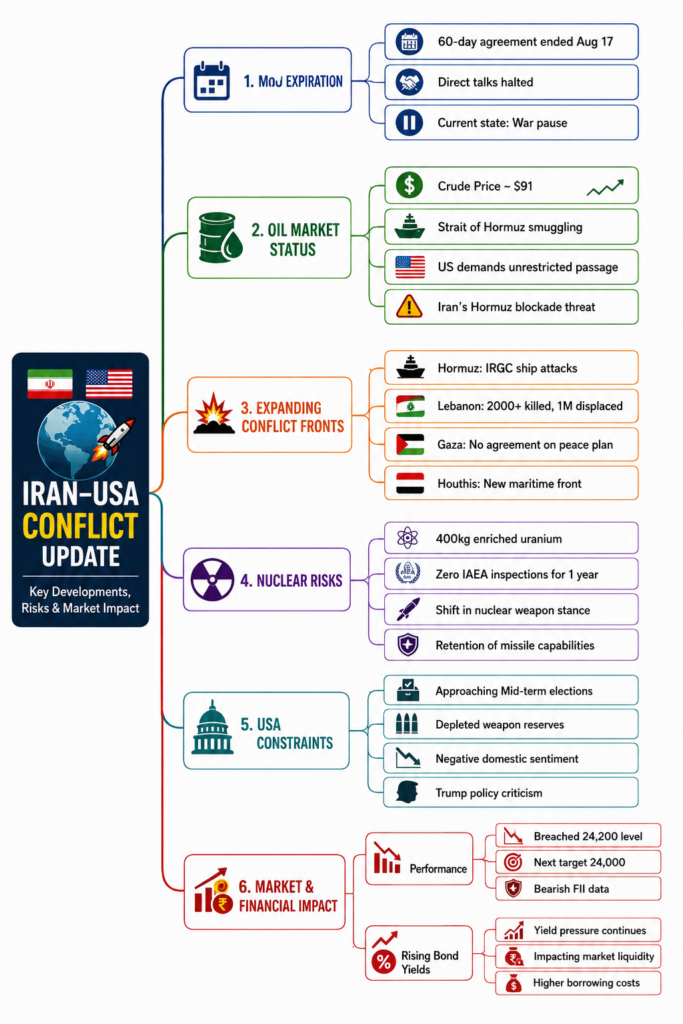
19. The Five Numbers Every Indian Investor Should Watch
If the Iran-USA conflict remains unresolved, keep these five indicators on your dashboard:
🛢️ 1. Brent Crude
$90 → warning zone
$100+ → serious macro risk
💵 2. USD/INR
A weakening rupee increases imported inflation pressure.
📈 3. US 10-Year Yield
Higher yields can pull global capital toward US fixed income.
⚡ 4. India VIX
A sudden expansion confirms volatility repricing.
📊 5. Nifty 50
24,000 is the key psychological level in the current setup.
20. The Real Risk Is Not One Headline
Investors often ask:
“Will Iran attack?”
That is the wrong question for the stock market.
The better question is:
“What happens if the conflict continues long enough to change the global inflation and energy equation?”
Because markets can survive geopolitical headlines.
They struggle when those headlines become:
Persistent economic shocks.
If crude stays above $90 for weeks, the consequences are very different from a two-day spike.
If crude moves above $100 and stays there, the consequences become larger still.
Conclusion: The 60-Day Silence Has Ended—but the Next Move Is Still Unknown
The most dangerous feature of the current Iran-USA situation is not necessarily an immediate military escalation.
It is the loss of a clear diplomatic pathway.
The temporary framework has expired.
The Strait of Hormuz remains heavily disrupted.
Brent is around $91.
The IAEA continues to face major verification gaps concerning Iran’s nuclear programme.
Shipping traffic through Hormuz has fallen dramatically.
And Indian equities have already entered a seven-session losing streak.
For India, the transmission mechanism is clear:
Iran conflict
→ Hormuz risk
→ Crude oil ↑
→ Inflation ↑
→ Bond yields ↑
→ Rupee pressure
→ FII outflows
→ Nifty volatility
The key level now is 24,000.
If diplomacy returns and oil falls, the market could stage a powerful relief rally.
If Hormuz disruption worsens, crude crosses $100, and Nifty loses 24,000, the current correction could become considerably more serious.
The market is therefore not asking investors to predict war.
It is asking them to prepare for multiple possible outcomes.
In geopolitics, the biggest risk is often not the event itself—it is the market discovering that the event has lasted much longer than expected.
Disclaimer: This article is for market research and educational purposes, not a guaranteed forecast or personalized investment advice. Geopolitical developments can change rapidly.
Top 10 SEO Titles
- Iran USA Conflict 2026: 5 Reasons the Strait of Hormuz Crisis Could Trigger a Global Oil Shock
- Iran USA War 2026: What the Strait of Hormuz Crisis Means for Oil, Nifty and India
- Strait of Hormuz Crisis 2026: Why Crude Oil Could Surge Above $100
- Iran USA Conflict: 7 Risks That Could Trigger the Next Global Market Shock
- Iran War 2026: How Rising Oil Prices Could Hit Nifty 50 and the Indian Economy
- Iran USA Tensions 2026: Nuclear Risk, Oil Shock and the Threat to Global Markets
- Nifty 50 Under Pressure: How the Iran Conflict and $90 Oil Could Change the Market
- Iran Crisis 2026 Explained: Hormuz, Crude Oil, Inflation and Nifty 50 Impact
- Could Iran Conflict Push Oil Above $100? 5 Risks Investors Should Watch
- Iran-USA Conflict 2026: The Hidden Oil Shock That Could Hit India’s Stock Market