
Same War. Same Oil. Completely Different Markets.
The most interesting story in global markets right now is not simply that Indian stocks are falling.
It is that Indian and US equities are reacting very differently to the same geopolitical shock.
The Middle East conflict is affecting global energy markets. Crude oil has moved back above $90 a barrel, the Strait of Hormuz remains a major risk point, and global bond yields are elevated.
Yet the US equity market recently pushed to record territory while India has entered a painful losing streak.
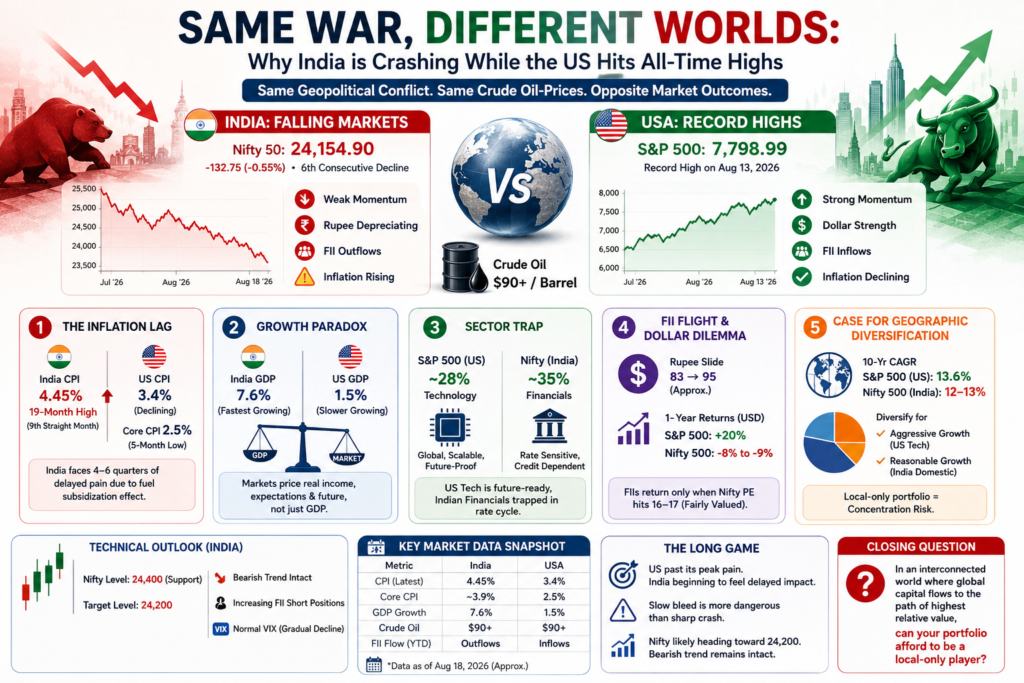
On August 13, 2026, the S&P 500 closed at a record 7,798.99. By August 17, however, it had pulled back 0.5% to 7,745.06 as oil and inflation concerns returned. Even after that pullback, Wall Street remained close to historical highs.
India tells a very different story.
On August 18, the Nifty 50 fell 132.75 points, or 0.55%, to 24,154.90, extending its losing streak to six sessions. The Sensex declined 492.70 points to 77,235.46. IT stocks were particularly weak, with the sector falling around 1.9%.
So the real question is:
If the shock is global, why is the market reaction so different?
The answer lies in inflation, currency, sector composition, valuations, earnings expectations and—most importantly—where global capital currently sees the better risk-adjusted return.
1. The First Difference: America Has Already Absorbed More of the Inflation Shock
One of the biggest differences is the inflation cycle.
US headline CPI declined to 3.4% in July 2026, down from 3.5% in June, while core CPI eased from 2.6% to 2.5%. That moderation has helped investors believe that the worst of the recent inflation pressure may be behind the US economy.
India is moving in the opposite direction.
India’s July 2026 CPI increased to 4.45%, up from 4.38% in June and above the RBI’s 4% medium-term target for the second consecutive month.
Food inflation reached 5.52%, while core inflation was around 3.9%.
That produces an important divergence:
| Indicator | United States | India |
|---|---|---|
| Latest CPI | 3.4% | 4.45% |
| Core CPI | 2.5% | ~3.9% |
| Direction | Moderating | Rising |
| Policy concern | Inflation easing | Food/energy pressure |
| Market reaction | Supports risk assets | Pressures valuations |
This does not mean US inflation is solved.
It means the direction of travel is currently more favourable for US equities.
2. India’s Inflation Problem Is More Complicated Than the Headline
There is an important correction to the popular narrative that India is simply “hiding” crude inflation through fuel-price controls.
The reality is more nuanced.
India’s domestic fuel prices do not always move one-for-one with international crude prices. That can delay the immediate CPI transmission.
But the shock can still enter the economy through:
- transportation costs
- logistics
- aviation
- chemicals
- plastics
- paints
- manufacturing inputs
- fertilizers
- corporate margins
- government finances
- currency depreciation
Therefore, the real risk is not necessarily one huge CPI spike.
It is persistent second-round inflation.
If crude stays above $90 for several months, companies eventually have to choose between:
higher prices → weaker demand
or
absorbing costs → lower margins.
Neither is ideal for equity valuations.
3. The Growth Paradox: India Is Growing Faster, Yet Its Market Can Still Fall
This is where many investors make a mistake.
They assume:
Higher GDP growth = higher stock-market returns.
It doesn’t work that way.
India’s real GDP for FY2025-26 is estimated to have grown 7.6%, according to the latest official annual estimate.
Meanwhile, US real GDP increased at an annualised 1.5% in Q2 2026, down from 2.1% in Q1.
At first glance, India should clearly win.
But stock markets don’t price today’s GDP.
They price:
Future earnings × valuation multiple × liquidity × risk premium.
That equation changes everything.
A country can grow at 7.6% and still experience falling equities if investors believe:
- earnings expectations were too optimistic
- valuations were too high
- currency returns will deteriorate
- interest rates will stay higher
- foreign investors can earn better returns elsewhere
This is exactly why GDP and stock-market performance can diverge for long periods.
4. India’s Earnings Are Actually Strong—So Why Is Nifty Falling?
This is perhaps the most important contradiction in the current market.
India’s corporate earnings are not collapsing.
Quite the opposite.
Nifty 50 companies recorded approximately 18% average profit growth in the June 2026 quarter, the strongest growth rate in 10 quarters.
Nineteen sectors reportedly exceeded expectations, while the upgrade-to-downgrade ratio improved to approximately 1.5.
That means the current correction cannot simply be described as:
“Indian companies are performing badly.”
The better explanation is:
Good earnings are being discounted against a higher risk premium.
Think about it this way.
If a company is expected to grow earnings 15%, but investors previously paid 30× earnings for that growth, and now they are willing to pay only 23×, the share price can fall even while profits increase.
This is called valuation de-rating.
And that may be one of the most important themes in the Indian market right now.
5. The Valuation Problem: India Still Isn’t Cheap
This is where the India-US comparison becomes particularly interesting.
As of early August, broader Indian equities were still trading at elevated valuation levels. One market dataset put the aggregate Indian market P/E around 23.5×, while the Nifty 500 had gained only modestly over the prior year.
That means investors cannot simply say:
“Nifty has fallen, therefore India is cheap.”
A correction does not automatically create a bargain.
The real question is:
Has price fallen faster than earnings expectations?
If earnings remain strong while prices correct, valuations can eventually become more attractive.
But if earnings estimates are also cut, the valuation problem may persist.
6. Meanwhile, Wall Street Has a Different Earnings Engine
The S&P 500 has a very different sector structure.
Technology and communication-related mega-cap companies have become enormous contributors to index earnings and investor sentiment.
The AI investment cycle has created an additional source of earnings optimism.
Recent US market strength has been supported by strong corporate profits and enthusiasm around AI infrastructure, while S&P 500 earnings growth in Q2 was reported to be particularly strong, led by major technology companies.
This is one reason the same oil shock does not produce the same index-level effect.
India has a much larger domestic-financial and cyclical component.
The US has a much larger group of globally scalable technology businesses.
That distinction matters.
7. Sector Composition: The Hidden Reason Behind the Divergence
The two markets are fundamentally different baskets.
US Market
The S&P 500 has significant exposure to:
- Technology
- Communication services
- AI infrastructure
- Semiconductors
- Cloud computing
- Global software
- Digital advertising
Many of these companies generate revenue globally.
Their customer base is not limited to US consumers.
Indian Market
The Nifty has significant exposure to:
- Financials
- Banks
- Energy
- IT services
- Consumer companies
- Industrials
A large part of the earnings cycle is connected to:
Indian credit + Indian consumption + Indian rates + Indian currency.
Therefore, when Indian inflation rises, and the rupee weakens, the impact can spread across several large index constituents simultaneously.
8. The Dollar Is the Silent Weapon
For Indian investors, there is another variable that often gets ignored:
currency.
Suppose an Indian stock rises 5%.
Sounds good.
But if the rupee falls 5% against the dollar, the dollar-based return can be close to zero before transaction costs and taxes.
For an FII, the calculation is even more important.
Their decision is not:
“Will Nifty rise?”
It is:
“Will my total India investment return beat the alternatives after currency risk?”
That is a much harder hurdle.
This creates the Dollar Return Dilemma.
9. Why FII Selling Matters So Much
Foreign investors have been a major source of pressure on Indian equities in 2026.
Reuters reported that foreign investor outflows from Indian stocks had reached roughly $25 billion in 2026, amid concerns around high US Treasury yields and relative returns.
This is a critical point.
FIIs don’t necessarily need to believe that India is a bad economy.
They only need to believe that:
US equities + US bonds + dollar assets currently offer a better risk-adjusted opportunity.
That is enough to trigger capital rotation.
10. The US Bond Market Is Also Sending a Warning
There is a second side to the US story that bulls should not ignore.
US stocks may be near record highs, but Treasury yields have moved sharply higher.
On August 18, Reuters reported that the US 30-year Treasury yield reached its highest level since 2007, while the 10-year yield approached its highest level since January 2025.
That creates a potential problem for expensive growth stocks.
Higher yields mean:
Higher discount rate → lower present value of future earnings.
This is especially relevant for high-growth technology companies.
So the US market is not risk-free.
It is simply pricing the current risks differently.
11. The Crude Oil Paradox
Both markets are exposed to the same oil shock.
But oil affects them differently.
India
India is a major net importer of crude.
Higher oil can mean:
Higher import bill → weaker rupee → inflation → margin pressure → tighter financial conditions.
United States
The US is also an enormous energy consumer, but it is simultaneously one of the world’s largest oil and gas producers.
Therefore, higher oil prices can create winners inside the US equity market.
This is already visible.
On August 18, the S&P 500 energy sector was up around 1%, with the sector heading toward a potential record close and gaining more than 40% in 2026.
So the US market has a natural hedge:
Oil hurts consumers but can help US energy producers.
India has much less of that natural index-level hedge.
12. The Middle East Conflict Is Not Actually Being Ignored by Wall Street
This is an important distinction.
It would be incorrect to say:
“The US market is ignoring the war.”
It isn’t.
On August 18, US equities weakened as oil rose and Treasury yields jumped. Nvidia and Meta fell, semiconductor stocks declined sharply,y and the S&P 500 lost around 0.46% during the session.
The difference is that Wall Street entered the crisis from a much stronger technical and earnings position.
The S&P 500 had already achieved a record close of 7,798.99 on August 13.
India entered the same period with much weaker momentum.
That is the difference between:
a market correcting from strength
and
a market already trapped in a downtrend.
13. Nifty vs S&P 500: The Current Scorecard
| Factor | India | United States |
|---|---|---|
| Latest major index | Nifty 50 | S&P 500 |
| Recent direction | Bearish | Near record territory |
| Inflation | 4.45% | 3.4% |
| Core inflation | ~3.9% | 2.5% |
| GDP growth | 7.6% FY2025-26 | 1.5% Q2 annualised |
| Crude sensitivity | High | More balanced |
| Currency risk | Rupee | Dollar |
| Foreign capital | Heavy outflows | Strong equity demand |
| Earnings | Strong | Strong |
| Valuation | Elevated | Elevated |
| Main risk | Oil + currency + FII selling | Yields + AI valuation + oil |
The most surprising line in the table is:
Both markets have strong earnings.
Therefore, this is not simply a growth story.
It is a valuation and capital-allocation story.
14. The “Worst Is Behind the US, Worst Is Ahead for India” Argument
This popular narrative needs to be treated carefully.
There is evidence supporting the idea that US inflation has moderated.
But it is too early to say that the US has completely passed its worst inflation risk.
Similarly, it is too aggressive to claim that India faces four to six quarters of guaranteed inflationary pain.
The more defensible conclusion is:
India currently faces a higher probability of additional inflation pressure if crude remains elevated, while the US has entered this oil shock from a more favourable inflation trajectory.
That is a much stronger investment argument because it is based on probabilities rather than certainty.
15. What Could Reverse the India-US Divergence?
The current divergence is not permanent.
Several events could change the picture quickly.
Scenario 1: Oil falls below $80
If geopolitical tensions ease and Brent crude falls sharply, India’s inflation and currency pressure could reduce.
This would be strongly positive for Indian equities.
Scenario 2: Nifty earnings remain strong
The latest 18% profit growth is encouraging.
If earnings remain strong while valuations fall, India could become increasingly attractive.
Scenario 3: FII selling slows
A reduction in foreign outflows could provide an immediate liquidity boost.
Scenario 4: Rupee stabilises
Currency stability would reduce the dollar-return penalty faced by global investors.
Scenario 5: US valuations become too expensive
If US technology valuations become stretched while earnings growth slows, capital could rotate back toward emerging markets.
16. What Could Make the Divergence Even Worse?
The bearish case for India becomes stronger if:
- Brent crude remains above $90
- the rupee continues weakening
- food inflation stays elevated
- FII selling accelerates
- US Treasury yields remain high
- Indian earnings estimates are downgraded
- Nifty breaks major technical support
- geopolitical tensions around Hormuz worsen
That combination could create a classic:
Oil shock + currency shock + valuation compression
scenario.
17. The Technical Picture: Nifty Is Still the Weak Link
On August 18, Nifty closed at 24,154.90, its sixth consecutive losing session.
That makes 24,200 an important psychological and technical zone.
Immediate resistance
24,300–24,450
Important support
24,150–24,200
Bearish breakdown zone
Below 24,100
A sustained break below this area could expose:
24,000 → 23,850
On the other hand, a strong recovery above 24,450 would suggest that selling pressure is beginning to weaken.
The important point is:
Don’t predict the reversal. Let price confirm it.
18. The Bigger Lesson: GDP Is Not Your Portfolio Return
This is perhaps the biggest lesson for Indian investors.
India can grow at 7.6%.
The US can grow at 1.5%.
And the US stock market can still outperform.
Why?
Because equity returns depend on:
Earnings growth + valuation change + currency + liquidity + capital flows.
Not GDP alone.
A fast-growing economy can have an expensive stock market.
A slower-growing economy can have companies with extraordinary margins, global revenues and powerful competitive advantages.
Therefore:
Economic growth and stock-market returns are related—but they are not the same thing.
19. Geographic Diversification Is Not a Luxury
The current divergence highlights another important portfolio lesson:
Home bias is a risk.
An investor who owns only Indian equities is effectively making several bets simultaneously:
- India will outperform
- Rupee will remain stable
- Indian inflation will remain manageable
- RBI policy will remain supportive
- Domestic valuations will remain elevated
- Foreign capital will return
- Indian earnings will meet expectations
That’s a lot of assumptions.
A geographically diversified portfolio can distribute some of those risks across:
India + US + other global markets.
This does not mean investors should blindly buy US technology stocks.
It means portfolio construction should consider where the best risk-adjusted opportunities exist, rather than assuming they must always be domestic.
20. The Final Question: Is India Cheap Yet?
Not necessarily.
The correction has made some stocks and sectors more attractive, but the broader Indian market should not automatically be labelled “cheap.”
A better approach is to divide the market into three categories:
1. Expensive + weak earnings
Avoid/wait
2. Expensive + strong earnings
Watch valuation carefully
3. Reasonable valuation + strong earnings
Potential accumulation zone
This is where the next major opportunity may emerge.
The market does not need to crash for India to become attractive.
It simply needs:
prices to correct + earnings to remain high + macro risks to stabilise.
Conclusion: Same War, Different Starting Points
The US and India may be exposed to the same geopolitical conflict.
They may buy the same crude oil.
They may face the same global inflation shock.
But markets don’t react to events in isolation.
They react to starting valuations, sector composition, currency, earnings expectations, liquidity and investor positioning.
The US entered this crisis with:
- record corporate earnings
- strong AI investment
- powerful technology companies
- a stronger dollar
- a recent record S&P 500 close
India entered with:
- elevated valuations
- foreign capital outflows
- a weakening currency
- rising inflation
- high crude sensitivity
- a weakening Nifty trend
That is why the same war can create two completely different stock-market outcomes.
The key takeaway for investors is not:
“Sell India and buy America.”
It is:
Follow the relative value, understand the currency, watch earnings, and never confuse economic growth with stock-market returns.
The next major move in Indian equities may ultimately depend less on the headline GDP number and more on four variables:
Crude oil.
Rupee.
FII flows.
Earnings.
If those four improve together, the Nifty can recover quickly.
If they deteriorate together, 24,200 may only be the beginning of the valuation reset.
Key Data Snapshot — August 18, 2026
| Metric | Latest Data |
|---|---|
| Nifty 50 | 24,154.90 |
| Nifty daily move | -0.55% |
| Nifty losing streak | 6 sessions |
| Sensex | 77,235.46 |
| India CPI, July 2026 | 4.45% |
| India food inflation | 5.52% |
| US CPI, July 2026 | 3.4% |
| US core CPI | 2.5% |
| India FY2025-26 GDP growth | 7.6% |
| US Q2 2026 GDP | 1.5% annualised |
| Nifty 50 Q1 FY27 profit growth | ~18% |
| Brent crude | ~$91/barrel |
| Reported 2026 FII outflows | ~$25 billion |
| S&P 500 record close, Aug. 13 | 7,798.99 |
Sources: Reuters, U.S. BEA, Government of India/PIB and market data reports.
SEO FAQ
Why is Nifty falling while the S&P 500 is near record highs?
The divergence is being driven by differences in inflation, currency risk, sector composition, foreign capital flows, valuations and investor positioning. Nifty is also facing greater sensitivity to crude oil and the rupee.
Is India growing faster than the US?
Yes. India’s FY2025-26 real GDP growth estimate is 7.6%, while US Q2 2026 real GDP grew at a 1.5% annualised rate. But GDP growth does not directly determine stock-market returns.
Why is crude oil more dangerous for India?
India is highly dependent on imported crude. Sustained higher oil prices can pressure the import bill, rupee, inflation and corporate margins.
Why are US stocks still strong despite the Middle East war?
US stocks have benefited from strong corporate earnings, AI-related investment and a favourable inflation trajectory. However, higher oil prices and Treasury yields are now creating pressure on US technology valuations as well.
Will Nifty fall to 24,000?
24,000 is a possible technical level if selling continues, but it is not a guaranteed target. Traders should watch the 24,100–24,200 zone and look for confirmation through price, volume and market breadth.
Should Indian investors invest in US stocks?
Geographic diversification can reduce concentration risk, but investors should consider valuation, currency risk, taxation, fund structure and investment horizon before allocating capital internationally.
Disclaimer: This article is for educational and informational purposes only and does not constitute investment advice or a recommendation to buy or sell any security. Market conditions, geopolitical developments, currency movements, and commodity prices can change rapidly.
Top 10 SEO titles best rahenge:
- Why Nifty Is Falling While S&P 500 Hits Record Highs: India vs US Market
- India vs US Stock Market: Why Nifty Is Falling While S&P 500 Rallies
- Nifty vs S&P 500: Why India Is Falling While US Stocks Hit Record Highs
- Why Is Nifty Falling? Crude Oil, FII Outflows and US Market Rally Explained
- India Stock Market Crash vs US Rally: The Real Reason Behind the Divergence
- Same War, Different Markets: Why Nifty Is Falling, and S&P 500 Is Rising
- Nifty 50 vs S&P 500: Inflation, Crude Oil, FII Flows and Valuation Explained
- Why Foreign Investors Are Leaving India While US Stocks Stay Strong
- India vs America Stock Market: Crude Oil, Inflation and Dollar Return Explained
- Nifty 50 Bearish Trend: Why US Stocks Are Outperforming Indian Markets