
Nifty 50 Today: Sixth Straight Session of Losses
The Indian stock market is no longer dealing with a single negative trigger. It is dealing with an accumulation of uncertainty.
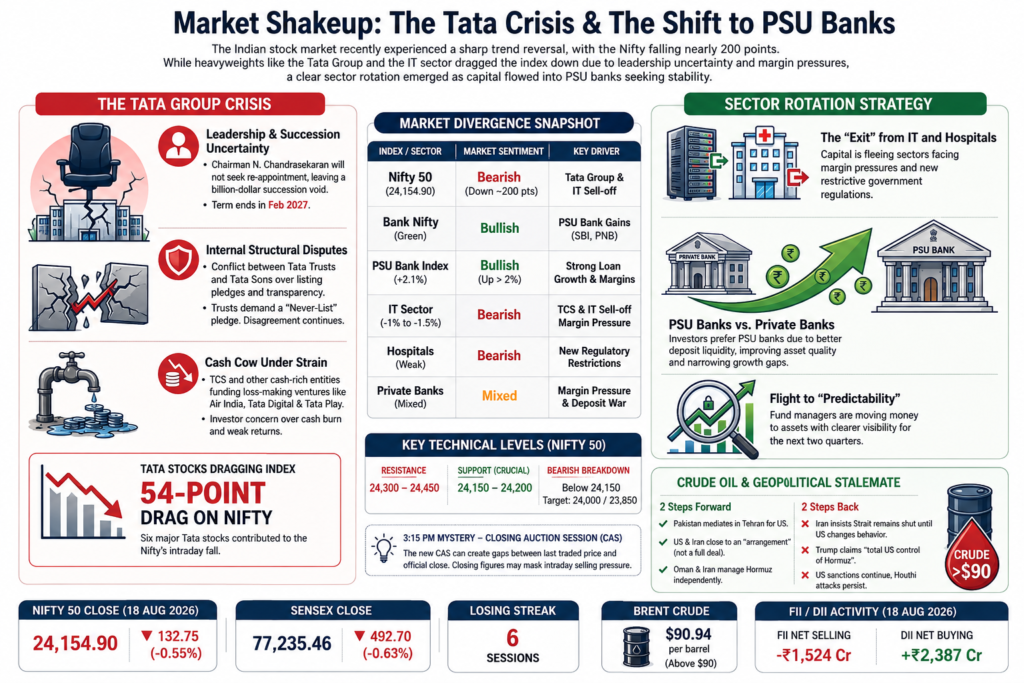
On Tuesday, August 18, 2026, the Nifty 50 closed at 24,154.90, falling 132.75 points or 0.55%. The Sensex declined 492.70 points or 0.63% to 77,235.46.
More importantly, Nifty extended its losing streak to six consecutive trading sessions. Persistent geopolitical tensions, elevated crude oil prices, and weakness in heavyweight stocks continued to pressure sentiment.
The market’s message is becoming clearer:
Investors are demanding visibility—and they are increasingly unwilling to pay for uncertainty.
This is what I call the “Uncertainty Tax.”
1. The Tata Factor: When Leadership Uncertainty Becomes a Market Risk
The biggest corporate story hanging over Indian equities is the unexpected succession battle at the Tata Group.
N. Chandrasekaran has confirmed that he will not seek another term as Chairman of Tata Sons after his current tenure ends in February 2027.
The announcement came despite Tata Trusts previously approving his reappointment, creating questions about the future leadership structure of one of India’s largest business groups.
The market is not simply worried about one individual’s departure.
It is worried about three interconnected issues:
- Who will lead Tata Sons after February 2027?
- What will happen to the group’s capital-allocation strategy?
- What is the future of Tata Sons’ listing and governance structure?
Noel Tata, Chairman of Tata Trusts, has become an increasingly important figure in these decisions. Reuters reported that Noel is expected to play a decisive role in both the selection of the next Tata Sons chairman and the group’s listing question.
And then came another warning signal.
The Tata Sons AGM scheduled for August 18 was adjourned because of a lack of quorum, reportedly the first such occurrence in the company’s history.
That development adds another layer to the perception of internal governance friction.
However, investors should make an important distinction:
Leadership uncertainty at Tata Sons does not automatically mean operational problems at every Tata-listed company.
TCS, Tata Steel, Tata Motors and other operating businesses have their own boards, management teams and business fundamentals.
Therefore, the market reaction should be viewed as a governance-risk discount, not necessarily as evidence that the underlying businesses have suddenly deteriorated.
2. TCS Becomes the Symbol of Tata Uncertainty
Among Tata Group companies, TCS remains particularly important because of its enormous weight in Indian equity benchmarks.
On August 18, TCS declined approximately 1.47% to ₹2,281, while several other IT stocks also remained under pressure. TCS was still down more than 30% from its reported 52-week high.
This matters because when a heavyweight stock falls, the effect is not limited to that company.
It affects:
- Nifty index contribution
- IT-sector sentiment
- large-cap fund positioning
- institutional risk appetite
- broader market psychology
The important question for investors is therefore not:
“Is TCS a good company?”
The better question is:
“How much uncertainty is the market willing to tolerate before it starts reducing exposure?”
That distinction is critical during periods of institutional selling.
3. The Bigger Macro Problem: Crude Oil Above $90
The Tata story alone does not explain today’s weakness.
The second major pressure point is crude oil.
Brent crude was trading around $90.94 per barrel on August 18, while other market reports placed Brent above $91 during the session.
For India, this is particularly important because India remains heavily dependent on imported crude.
Higher oil prices can create pressure through:
- higher import bills
- rupee depreciation risk
- inflation expectations
- higher input costs
- pressure on corporate margins
- potential impact on interest-rate expectations
This creates a difficult environment for equities.
Why $90 matters
The $90 level is not a magical economic threshold.
It is important because it becomes a psychological and macro-risk threshold.
If crude remains elevated for an extended period, the market may start pricing in:
Higher inflation → weaker margins → slower consumption → lower earnings expectations.
That is why investors are watching oil almost as closely as they are watching Nifty itself.
4. The Strange Divergence: Banks vs the Nifty
One of the most interesting developments in recent sessions has been the relative resilience of financial stocks compared with other parts of the market.
But there is an important nuance.
It is not accurate to say that all banks are benefiting equally.
The market is becoming increasingly selective.
Private-bank stocks have faced margin concerns. HDFC Bank, for example, has experienced pressure after concerns around net interest margins, while Axis Bank and Kotak Mahindra Bank have also faced stock-specific pressure during recent sessions.
At the same time, PSU banks have attracted renewed investor attention.
This creates a very interesting private-bank vs PSU-bank rotation.
5. Why PSU Banks Are Getting Attention
The PSU-bank story is based on several factors.
1. Valuation
Many PSU banks continue to trade at substantially different valuation multiples compared with premium private lenders.
2. Asset Quality
The improvement in asset quality over the past few years has changed the perception of several government-owned banks.
3. Earnings Momentum
Recent results have shown that some PSU lenders are generating strong profit growth.
4. Credit Growth
Loan growth remains an important earnings driver for the banking sector.
5. Relative Positioning
When investors believe premium private banks have limited near-term upside because of margin pressure, PSU banks can become a tactical alternative.
This is not necessarily a permanent change in the Indian banking hierarchy.
It may simply be a relative-value trade.
That distinction matters.
6. The PNB Example: Why Investors Are Watching PSU Banks
Punjab National Bank has emerged as one of the names attracting strong attention in the PSU-bank space.
Recent market commentary highlighted strong earnings, improving asset quality and loan growth as important factors behind renewed interest in the stock. On July 20, the Nifty PSU Bank index gained around 2.8%, while PNB surged around 5.7% after reporting a sharp rise in quarterly profit.
That earlier move helps explain why PSU banks have remained on institutional investors’ radar.
But investors should avoid extrapolating one strong session into a long-term structural bull market.
The key question is:
Can PSU banks sustain earnings growth without compromising asset quality?
That is the real test.
7. Private Banks Have Their Own Problem: The Margin War
The private-bank story is more complicated.
HDFC Bank recently became a major example of how investors are focusing on Net Interest Margin (NIM) rather than simply headline profit.
Reuters reported that HDFC Bank’s NIM had fallen to around 3.26%, compared with around 4% before the HDFC merger, while competition for deposits and funding costs remained important concerns.
This creates a difficult equation:
Loan growth + expensive deposits = pressure on margins.
Therefore, the market is increasingly rewarding banks that can demonstrate:
- strong deposit growth
- controlled funding costs
- stable NIM
- low credit costs
- strong asset quality
- sustainable loan growth
This explains why the current banking rotation should not simply be interpreted as:
“PSU banks good, private banks bad.”
The real story is:
“Investors are becoming more sensitive to the price of growth.”
8. The 3:15 PM Mystery: Understanding the Closing Auction Session
Another important development for traders is India’s new Closing Auction Session (CAS).
The mechanism has already produced unusual differences between prices observed near the end of continuous trading and official closing prices.
Earlier reports highlighted instances where Nifty was trading around 24,589 just before 3:15 PM, while the auction process subsequently influenced the official closing price. Traders also flagged divergence between Nifty spot and Bank Nifty spot/futures prices.
This is extremely important for intraday traders.
The key lesson:
3:15 PM is no longer necessarily the final reference point for the official close.
The Closing Auction Session can influence the final closing price.
Therefore, traders analysing:
- daily candles
- support/resistance
- option settlement
- backtests
- historical OHLC
- gap calculations
need to understand how CAS affects the closing price.
This is particularly important for algorithmic and systematic traders.
9. Crude Oil + Hormuz: The Global Risk Nobody Can Ignore
The geopolitical backdrop remains extremely fragile.
On August 18, reports indicated that the diplomatic situation between the US and Iran had deteriorated.
Pakistan has been attempting to facilitate communication, while Iran has maintained that the Strait of Hormuz will remain closed unless its conditions are met.
At the same time, US President Donald Trump said there were no talks currently scheduled with Iran and maintained that Hormuz was open, creating a sharp contradiction with Tehran’s position.
The market therefore has to price two different possibilities:
Bullish scenario for equities
Diplomacy resumes → Hormuz normalises → crude falls → inflation pressure eases → risk appetite returns.
Bearish scenario
Diplomacy fails → shipping disruption continues → crude remains above $90 → inflation and margin fears increase → equities remain under pressure.
This is why crude has become a market-wide variable, not simply an energy-sector issue.
10. What the Earnings Data Says
There is an important counterargument to the bearish narrative.
Corporate earnings are not collapsing.
Reuters reported on August 18 that Nifty 50 companies recorded approximately 18% average profit growth in the June 2026 quarter, the strongest growth rate in 10 quarters.
Nineteen sectors reportedly exceeded expectations, while the upgrade-to-downgrade ratio improved to around 1.5.
This creates a fascinating market setup.
Fundamental picture:
Earnings = relatively strong
Market picture:
Index = weak
Macro picture:
Crude + geopolitics = negative
Corporate picture:
Tata succession uncertainty = additional risk premium
This suggests the current correction is not necessarily a pure earnings-driven bear market.
It is increasingly a valuation + macro + positioning + uncertainty event.
11. Nifty Technical View: 24,200 Is the Battlefield
From a technical perspective, the most important zone is now around 24,200.
Nifty closed at:
24,154.90
That puts the index below the psychologically important 24,200 level.
The technical structure therefore deserves close attention.
Immediate resistance
24,300–24,450
A sustained recovery above this zone would indicate that sellers are losing some control.
Major support
24,150–24,200
This is the immediate battlefield after today’s close.
Bearish confirmation
A decisive breakdown below 24,150/24,100 could increase the probability of a move toward:
24,000 → 23,850
Bullish recovery
If Nifty reclaims 24,450 with strong breadth and volume, the current bearish structure could begin weakening.
The important point is that traders should not predict the next move purely from one candle.
Price + volume + breadth + global cues should confirm the direction.
12. What Investors Should Watch Next
The next few sessions could be driven by five variables.
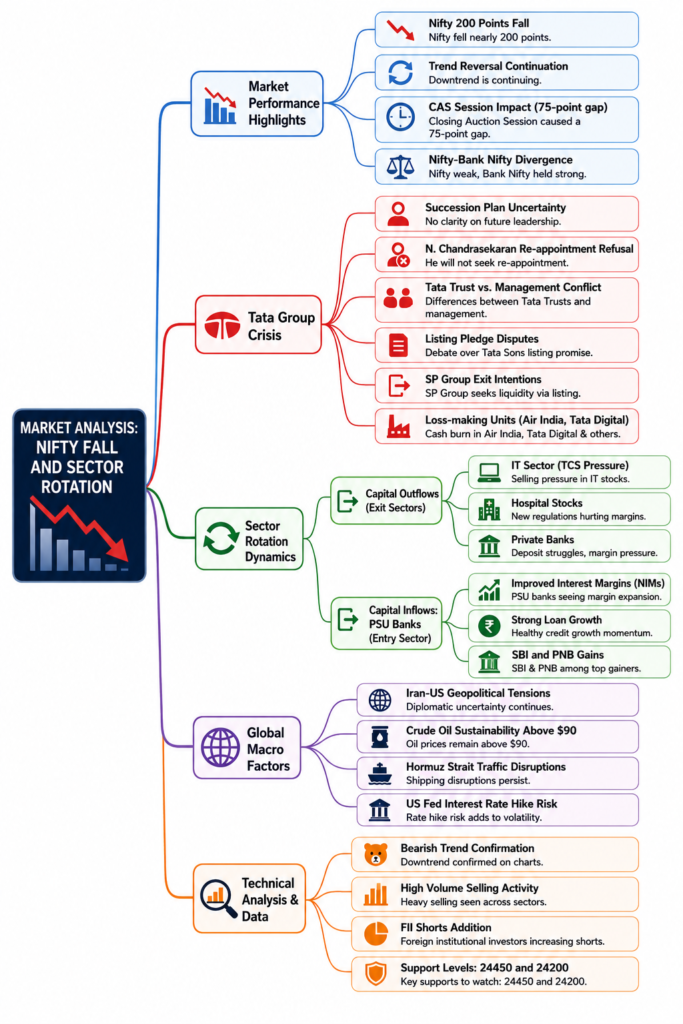
| Factor | Bullish Signal | Bearish Signal |
|---|---|---|
| Nifty | Above 24,450 | Below 24,150 |
| Crude | Below $90 | Sustained above $90 |
| Tata | Succession clarity | More governance uncertainty |
| PSU Banks | Earnings + asset quality | Profit booking |
| Hormuz | Shipping normalisation | Further disruption |
This creates a simple market dashboard.
Green flags
- Crude falls below $90
- Hormuz traffic normalises
- Nifty reclaims 24,450
- FII selling reduces
- Bank breadth improves
- Tata succession uncertainty cools
Red flags
- Crude remains above $90
- Nifty breaks 24,100
- FII selling accelerates
- IT weakness continues
- Private-bank margins deteriorate
- Middle East tensions escalate
13. The Bigger Investment Lesson
The most important lesson from this market is not about Tata.
It is not about PSU banks.
It is not even about crude.
It is about visibility.
Markets can tolerate bad news when the outcome is measurable.
What markets struggle with is:
“We don’t know what happens next.”
That is the real Uncertainty Tax.
Tata investors are trying to understand the next leadership structure.
Oil investors are trying to understand the next geopolitical development.
Bank investors are trying to understand the next NIM cycle.
Equity investors are trying to understand whether the Nifty correction is temporary or the beginning of a deeper trend.
In such an environment, capital naturally moves toward areas where the probability distribution looks clearer.
That explains why PSU banks can suddenly become attractive while IT, selected private banks and other heavyweight sectors remain under pressure.
Final Verdict: Don’t Confuse Rotation With a New Bull Market
The current market does not yet provide enough evidence to declare a new long-term leadership cycle.
What we are seeing is better described as tactical capital rotation.
The Nifty has fallen for six consecutive sessions and closed at 24,154.90, while crude remains around the psychologically important $90+ zone and geopolitical uncertainty remains elevated.
At the same time, corporate earnings remain surprisingly resilient, with Nifty 50 profit growth reaching approximately 18% in the June quarter.
That contradiction is what makes the current market so interesting.
Weak index + strong earnings + expensive crude + geopolitical risk + Tata succession uncertainty = a market driven by risk premium rather than fundamentals alone.
For investors, the strategy should therefore be simple:
Do not chase the strongest sector after one rally.
Do not blindly buy a falling blue chip because it looks “cheap.”
Wait for visibility, confirmation and valuation.
The trend may eventually turn.
But until the market proves it, capital preservation should remain more important than prediction.
Key Data Points at a Glance
- Nifty 50 close: 24,154.90
- Nifty daily fall: 132.75 points / 0.55%
- Nifty losing streak: 6 sessions
- Sensex close: 77,235.46
- Sensex fall: 492.70 points / 0.63%
- Brent crude: around $90–$92/bbl
- TCS August 18 move: about -1.47%
- June-quarter Nifty 50 profit growth: ~18%
- Nifty earnings upgrade/downgrade ratio: ~1.5
- Tata Sons Chairman: N. Chandrasekaran
- Current Tata Sons term end: February 2027
- Tata Sons AGM on August 18: Adjourned due to lack of quorum
- Key Nifty technical zone: 24,150–24,200
- Major recovery zone: 24,300–24,450
SEO FAQ
Why is Nifty falling today?
Nifty fell because of a combination of elevated crude oil prices, geopolitical uncertainty, continued selling in heavyweight stocks,s and concerns surrounding Tata Group leadership. The index closed at 24,154.90 on August 18, 2026.
Why are PSU banks outperforming?
PSU banks have attracted investor attention because of improving earnings, asset quality, valuations and expectations around credit growth. The rotation is currently more tactical than proof of a permanent shift away from private banks.
What happened to Tata Sons?
N. Chandrasekaran has said he will not seek another term as Tata Sons Chairman after his current tenure ends in February 2027. Tata Sons’ August 18 AGM was also adjourned due to lack of quorum, adding to the current governance and succession uncertainty.
Is crude oil above $90 bearish for India?
Sustained crude prices above $90 can be negative for India because they can increase the import bill, inflation pressure, re and corporate input costs while potentially putting pressure on the rupee.
Is 24,200 an important Nifty support?
Yes. With Nifty closing at 24,154.90, the 24,150–24,200 area has become an important near-term technical zone. A sustained breakdown could increase downside risk, while a recovery above 24,450 would improve the technical picture.
Is the Nifty in a bear market?
It is too early to make that structural call based only on the current correction. The index is technically weak, but corporate earnings remain relatively strong. Investors should watch price, breadth, earnings revisions, crude, and institutional flows together.
Disclaimer: This article is for educational and informational purposes only. It is not investment advice or a recommendation to buy or sell any security. Market conditions can change rapidly, particularly during periods of geopolitical and commodity-market volatility.
Alternative titles:
- Nifty 50 Falls: Tata Group Crisis and PSU Bank Sector Rotation Explained
- Nifty Market Shakeup: Tata Succession Crisis, Crude Oil & PSU Banks
- Why Nifty Is Falling: Tata Crisis, PSU Banks Rally and Crude Oil Impact
- Nifty 50 Bearish Trend: Tata Crisis, PSU Bank Rotation & Global Risks
- Tata Crisis Shakes Nifty: Why Investors Are Rotating Into PSU Banks