

Introduction: Why Did Nifty Fall Below 23,000?
The Indian stock market faced renewed selling pressure in September 2026 as geopolitical uncertainty, rising crude oil prices, foreign investor outflows and higher global bond yields weighed on investor sentiment.
On September 28, the Nifty 50 plunged 360.25 points, or 1.56%, to close at 22,780.25. The decline continued on September 29, when the index closed at 22,716.20, down another 0.28%. The Sensex finished the same session at 72,529.07.
These levels placed the benchmark indices near six-month lows. The market weakness was not limited to large-cap stocks; mid-cap and small-cap indices also experienced selling pressure.
The central question for investors is whether the decline represents a temporary reaction to geopolitical and macroeconomic uncertainty or a more prolonged adjustment in equity valuations.
Several interconnected factors help explain the recent correction.
1. Rising Crude Oil Prices Are Pressuring Indian Equities
Crude oil has emerged as one of the major variables influencing the Indian stock market.
Brent crude climbed above $108 per barrel during the September 28 session amid concerns surrounding the US-Iran conflict and potential disruptions to shipping through the Strait of Hormuz. Prices remained elevated around $106 per barrel on September 29.
India’s dependence on imported crude makes the economy particularly sensitive to sustained increases in international oil prices.
How expensive oil affects India
Higher import costs: A higher oil bill can increase the country’s merchandise import expenditure and widen the trade deficit.
Rupee pressure: Greater demand for foreign currency to pay for energy imports can add pressure to the rupee.
Corporate margins: Companies in aviation, paints, chemicals, logistics and other fuel-intensive industries may face higher operating expenses.
Inflation risk: Persistent energy costs can affect transportation, manufacturing, food distribution and consumer prices.
However, the impact differs by company. Oil producers, refiners, distributors and companies with pricing power may respond differently from businesses that cannot pass higher costs on to customers.
For equity investors, the important distinction is between a temporary crude price spike and a prolonged period of elevated energy prices.
2. Foreign Institutional Investors Are Selling Indian Stocks
Foreign institutional investor selling has added to domestic market pressure.
According to market reports, foreign investors sold approximately ₹5,353 crore worth of Indian equities on September 28. Domestic institutional investors purchased approximately ₹5,189 crore during the same session, partially offsetting the selling.
FII versus DII flows
| Indicator | September 28, 2026 |
|---|---|
| FII/FPI net equity activity | Approximately -₹5,353 crore |
| DII net equity activity | Approximately +₹5,189 crore |
| Combined net flow | Approximately -₹164 crore |
Figures are approximate and refer to reported equity flows for the specified session.
Foreign investors may reduce exposure to emerging markets when global yields rise, currency risks increase, or geopolitical uncertainty intensifies. Domestic institutional buying can provide a partial cushion, but it does not guarantee an immediate market recovery.
Investors should monitor daily flows alongside earnings expectations, valuations, currency movements and global liquidity conditions rather than treating one session’s figures as a long-term trend.
3. Rising US Treasury Yields Are Affecting Valuations
Bond yields influence how investors value future corporate earnings.
When government bond yields rise, relatively safe fixed-income investments may become more attractive compared with equities. Higher discount rates can also reduce the present value of expected future corporate cash flows, particularly for expensive growth stocks.
The US 10-year Treasury yield was reported around 5.24% on September 29, adding to concerns about global financing conditions.
Why this matters for Indian equities
- Foreign investors may demand higher expected returns to hold emerging-market assets.
- Companies with substantial borrowing requirements may face tighter financing conditions.
- High-valuation stocks can become more sensitive to changes in discount rates.
- Currency depreciation can amplify returns volatility for international investors.
A higher Treasury yield does not automatically mean Indian interest rates must rise by the same amount. Domestic inflation, RBI policy, liquidity conditions and India’s growth outlook remain important independent factors.
4. Is the RBI Likely to Increase Interest Rates?
Higher energy prices can create an inflation challenge for central banks. If crude oil remains elevated, policymakers may have to assess the risk of imported inflation and second-round price increases.
However, a surprise 50-basis-point RBI rate hike should be treated as a scenario rather than a confirmed outcome.
The policy response would depend on several factors:
- Actual consumer price inflation and its composition.
- Inflation expectations and the persistence of energy-price increases.
- Domestic economic growth and credit conditions.
- The rupee’s movement and imported inflation.
- Liquidity conditions and financial-market stability.
A rate increase could put pressure on interest-rate-sensitive sectors, including real estate, housing finance and highly leveraged businesses. Conversely, a pause or less restrictive policy outlook could ease some valuation concerns if inflation pressures moderate.
Investors should distinguish between market speculation about future RBI decisions and an officially announced monetary policy decision.
5. Banking Stocks Face Multiple Sources of Pressure
Financial stocks have contributed to the recent market weakness. Rising bond yields, funding costs, deposit competition and concerns about economic growth can affect banks and non-banking financial companies through different channels.
Four factors investors should monitor
Bond portfolio valuation: Rising government bond yields generally reduce the market value of existing fixed-rate bonds. The effect on reported bank profits depends on the portfolio classification, accounting treatment and hedging arrangements.
Deposit competition: Banks competing aggressively for deposits may experience pressure on their funding costs and net interest margins.
Credit quality: Higher borrowing costs and weaker economic conditions may affect vulnerable borrowers, particularly in riskier retail and unsecured lending segments.
Foreign portfolio allocation: Banks with substantial foreign investor ownership may be affected by broad reductions in emerging-market equity exposure.
It is important not to confuse falling bank share prices with evidence of a banking solvency crisis. A conclusion about balance-sheet health requires company-specific information on capital adequacy, asset quality, liquidity, deposits and credit costs.
6. Sector-Wise Impact of the Market Correction
The effect of expensive crude oil and elevated yields varies across industries.
| Sector | Potential pressure | Important indicators |
|---|---|---|
| Banking | Funding costs, bond valuation and credit risks | NIM, deposits, GNPA, credit costs |
| NBFCs and housing finance | Borrowing costs and funding availability | Cost of funds, spreads, asset quality |
| Realty | Mortgage affordability and project financing | Sales bookings, collections, debt |
| Automobile | Financing costs and input expenses | Sales volumes, margins, inventory |
| Aviation | Fuel expenses and currency exposure | Fuel costs, passenger yields, debt |
| Paints and chemicals | Petroleum-derived input costs | Gross margins, pricing power |
| FMCG | Packaging costs and consumer purchasing power | Volume growth, operating margins |
| Pharmaceuticals | Currency, export demand and input costs | Order growth, margins, regulatory risks |
| Energy producers | Potential benefits from higher realised prices | Production, realised prices, operating costs |
These are potential transmission channels, not predictions that every company in a sector will experience the same outcome.
Businesses with strong balance sheets, manageable debt and pricing power may respond differently from competitors with weaker finances.
7. Nifty 50 Technical Analysis: Important Levels to Monitor
The September 29 closing price of 22,716.20 confirms that Nifty remained below the psychologically important 23,000 level.
A break below a round-number level can influence trading psychology, but technical levels should be assessed alongside price action, volume, volatility and market breadth.
Illustrative monitoring framework
| Price zone | How to interpret it |
|---|---|
| 23,000–23,100 | Potential overhead resistance zone |
| 22,800–23,000 | Area to watch for a recovery or rejection |
| 22,600–22,700 | Near-term price zone to monitor |
| Below 22,600 | Further downside risk if selling accelerates |
| Above 23,100 | Possible improvement in short-term price structure |
These zones are an analytical framework based on recent price levels, not confirmed support or resistance levels from a complete historical chart study. They should be recalculated using updated OHLC data.
Bullish scenario
A recovery above 23,000 followed by sustained trading above the level could indicate that selling pressure is moderating. Confirmation would require follow-through buying, improving market breadth and stabilisation in crude oil prices.
Bearish scenario
A sustained move below the recent intraday lows, accompanied by heavy selling and weak market breadth, could indicate additional downside risk.
Sideways scenario
If crude prices remain elevated but do not rise further, and institutional flows stabilise, Nifty could experience a period of volatile consolidation.
No single technical level guarantees a reversal or a continuation of the decline.
8. Three Possible Market Scenarios for October 2026
Rather than assuming one outcome, investors can use conditional scenarios to plan risk.
| Scenario | Conditions to monitor | Possible market implication |
|---|---|---|
| Recovery | Crude moderates, geopolitical risks ease, foreign selling slows | Improved risk appetite and potential relief rally |
| Consolidation | Oil remains elevated but stable, mixed institutional flows | Volatile trading without a clear trend |
| Further correction | Oil rises further, yields remain elevated, earnings expectations weaken | Increased valuation pressure and downside risk |
These scenarios are not forecasts, probabilities or price targets. Their purpose is to help investors identify which new information could change the market environment.
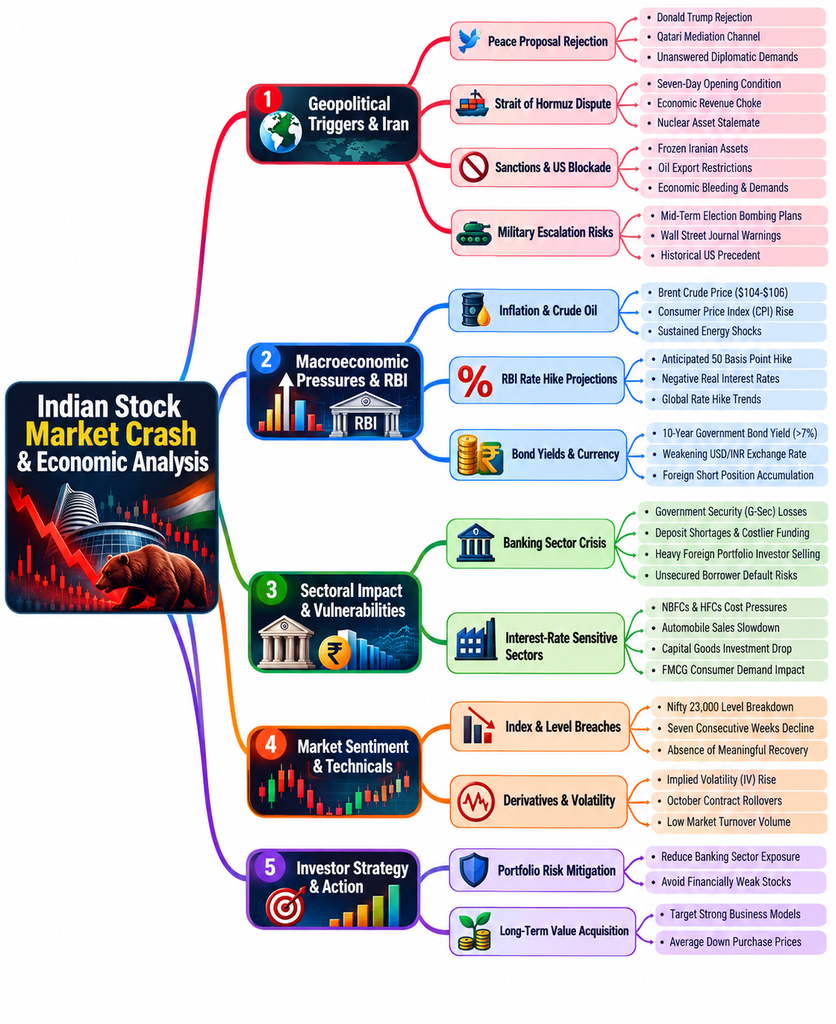
9. What Investors Should Review Before Buying the Dip
A falling share price alone does not establish that a stock is undervalued.
Before adding to a position, investors can review the following factors:
Valuation: Compare the current P/E, price-to-book ratio or enterprise-value multiples with historical ranges and relevant peers.
Earnings quality: Examine revenue growth, operating cash flow, profit margins and management guidance.
Balance-sheet strength: Review net debt, interest coverage, debt maturities and liquidity.
Business resilience: Assess whether the company can maintain margins if crude oil, borrowing costs or currency volatility remain elevated.
Portfolio concentration: Consider whether a portfolio is excessively exposed to one sector or a single macroeconomic risk.
Position sizing: Determine the maximum acceptable loss before entering a trade or investment.
For long-term investors, a staggered investment approach may help reduce the risk of committing all available capital at one price. It does not guarantee a profit or prevent losses.
Short-term traders should separately define their entry conditions, stop-loss levels, position sizes and exit rules.
10. Five Market Indicators to Track Daily
The following indicators can help investors monitor whether the current pressure is easing or intensifying.
| Indicator | What to watch |
|---|---|
| Brent crude oil | Whether prices stabilise or continue rising |
| USD/INR | Currency volatility and import-cost pressure |
| FII and DII flows | Whether domestic buying offsets foreign selling |
| US 10-year Treasury yield | Changes in global financing conditions |
| Nifty market breadth and volatility | Whether selling is broad-based or concentrated |
The rupee closed at approximately ₹95.98 per US dollar on September 29 after touching a weaker level earlier in the session. Currency movements remain an important variable because India imports substantial quantities of crude oil.
Daily market data should be checked against the latest exchange releases and official publications before being used for trading decisions.
Conclusion: Is the Nifty Correction Only About Crude Oil?
The decline below 23,000 reflects several interacting pressures rather than one isolated factor. Elevated crude oil prices, geopolitical uncertainty, foreign investor selling, higher global bond yields and currency weakness have contributed to a difficult environment for Indian equities.
At the same time, these developments do not by themselves prove that corporate earnings are collapsing, that the RBI will deliver a surprise rate hike or that the market must fall to a particular target.
For investors, the key is to distinguish observed data from assumptions, assess individual company fundamentals and monitor changes in the macroeconomic environment.
The next phase of the market will depend in part on energy prices, institutional flows, inflation expectations, global yields and corporate earnings. A sustained improvement in several of these variables could change the current risk picture; further deterioration could prolong volatility.
Disclaimer: This article is for educational and informational purposes only. It is not personalised investment advice, a recommendation to buy or sell securities, or a guarantee of future market performance. Investors should conduct their own research and consider their financial circumstances and risk tolerance before making investment decisions.
Frequently Asked Questions (FAQs)
Why did Nifty fall below 23,000 in September 2026?
The decline coincided with rising crude oil prices, geopolitical uncertainty, foreign institutional selling and elevated global bond yields. These factors increased concerns about inflation, corporate margins and equity valuations.
What was the Nifty 50 closing level on September 29, 2026?
Nifty 50 closed at 22,716.20 on September 29, 2026, down approximately 0.28% for the session.
How do higher crude oil prices affect the Indian stock market?
Higher crude prices can increase India’s import bill, put pressure on the rupee, contribute to inflation,n and reduce margins for fuel-intensive businesses. The impact varies by sector and company.
Does a fall below 23,000 mean Nifty will continue falling?
No. A breakdown below a psychological level can increase caution, but it does not determine the next move. Investors should monitor price action, market breadth, global developments and company earnings.
Will the RBI increase interest rates because of higher oil prices?
A rate increase is one possible policy scenario if inflation pressures persist. The actual decision depends on incoming inflation data, growth conditions, currency developments and the RBI’s assessment of risks.
Is this a good time to buy stocks?
That depends on an investor’s time horizon, valuation assumptions, financial circumstances and risk tolerance. A lower market index does not automatically mean every stock is undervalued.
Which sectors are sensitive to high crude oil prices?
Aviation, paints, chemicals, logistics and some consumer businesses can face higher input costs. Oil producers, refiners and other energy-related companies may experience different effects depending on their business models and pricing structures.
Disclaimer
This article is for educational and informational purposes only and should not be considered financial or investment advice. The market data, technical analysis, price levels, and economic commentary presented are subject to change and may not reflect the latest market conditions.
Stock market investments are subject to market risks, including the potential loss of capital. The views and scenarios discussed do not guarantee future market performance. Readers should verify the information independently, conduct their own research, assess their risk tolerance, and consult a qualified financial advisor before making investment decisions.
The author and publisher shall not be held responsible for any financial losses arising from decisions made based on this content.
Top 10 SEO Titles
- Why Nifty Fell Below 23,000? 7 Reasons Behind the Market Crash
- Nifty 50 Crash 2026: Why Is the Indian Stock Market Falling?
- Indian Stock Market Crash: 7 Factors Behind the Nifty Decline
- Nifty Below 23,000: Impact of Crude Oil Prices and FII Selling
- Why Are Nifty and Sensex Falling? Latest Market Analysis
- Nifty 50 Analysis: Support, Resistance and October 2026 Outlook
- FII Selling in India: Why Foreign Investors Are Selling Stocks
- Indian Stock Market Outlook 2026: Crude Oil, Inflation and RBI Rates
- Nifty 50 Downtrend Explained: Banking Stocks and Global Market Risks
- Stock Market Crash Today: Key Reasons, Risks and Investor Strategy